


ESR Test (Erythrocyte Sedimentation Rate Test)
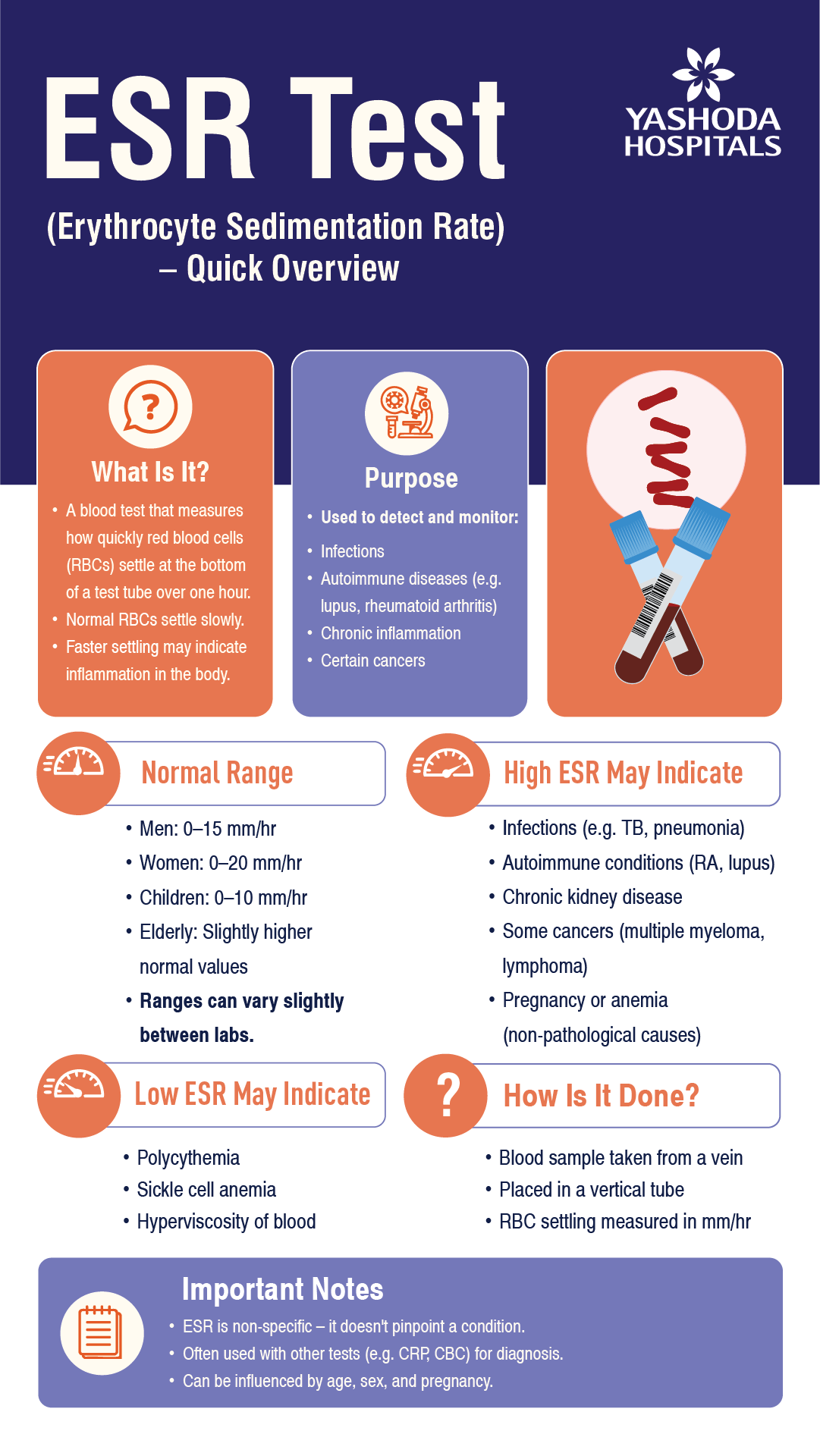
The Erythrocyte Sedimentation Rate (ESR) test is a straightforward and frequently used blood test that helps diagnose systemic inflammation. It measures the rate at which red blood cells (erythrocytes) settle to the bottom of a test tube over a specified period, typically 1 hour. A faster-than-normal rate of sedimentation (that is, accumulation of red blood cells at the bottom of the test tube) might specify the presence of inflammation caused by conditions like infections, autoimmune diseases, or some of the long-term diseases. Although the ESR test does not diagnose any single disease, it serves as a vital initial indicator of and monitor of inflammatory processes within the body.
 Uses of the Erythrocyte Sedimentation Rate
- To diagnose and calculate systemic inflammation in the body.
- To monitor underlying inflammatory diseases.
- To help in the diagnosis of short-term and long-term infections.
- To help in the diagnosis of autoimmune diseases.
- To observe the activity of disease in long-term inflammatory conditions.
- To track the development or remission of the disease.
- To examine the disease response to treatment (which includes medicines or any other form of treatment).
- To diagnose sudden outbreaks or relapses in long-term illnesses.
- To support the identification of disease when combined with other diagnostic methods, such as C-reactive protein, Complete blood count, Rheumatoid factor, and Antineutrophil Cytoplasmic antibody evaluation.
- To evaluate how serious the inflammatory response is.
- To detect hidden or subclinical inflammation.
- To examine tissue injury or necrosis indirectly.
- To help identify certain cancers, such as lymphoma and multiple myeloma.
- To observe inflammatory issues after undergoing a major surgery or trauma.
- To assist in differentiating between inflammatory and non-inflammatory conditions.
- To support examination of long-term diseases that affect multiple organs.
- To diagnose ongoing infections when symptoms are not clear.
- To assist in clinical decision-making and planning further diagnostic tests if required.
Indications Of Erythrocyte Sedimentation Rate Test
- Erythrocyte sedimentation rate is indicated when there are general signs of inflammation, like fever, fatigue, or malaise.
- When the patient presents with unexplained pain or swelling.
- When there is continuous joint pain or stiffness (suspected arthritis).
- When it is suspected that a patient has an autoimmune disease such as rheumatoid arthritis or systemic lupus erythematosus.
- When the doctor suspects the patient of having a short- or long-term infection, for example, tuberculosis.
- ESR is also indicated when examining for chronic inflammatory diseases.
- ESR is also recommended when there is unexplained weight loss or loss of appetite.
- ESR is indicated when anemia or another chronic disease is suspected.
- When evaluating anemia in the context of long-term disease.
- When polymyalgia rheumatica is suspected (muscle pain, stiffness), along with observing known inflammatory or autoimmune diseases
- When evaluating known inflammatory or autoimmune diseases, the effectiveness of these treatments in treating the inflammatory conditions.
- When the doctor suspects a major malignancy, it is primarily hematological cancers.
- ESR is also indicated when evaluating long-term kidney ailments or systemic issues.
- When examining long-term chronic kidney disease or systemic diseases, along with continuous and unexplained fever (PUO – Pyrexia of unknown origin).
- ESR is also recommended when there is post-surgical or post-traumatic inflammation monitoring, and when examining long-term infections like endocarditis or osteomyelitis.
- ESR is used to distinguish between organic disease and functional disorders, and in cases where clinicians require a baseline inflammatory marker before initiating treatment.
Preparation Before an ESR Test
- Before undergoing an erythrocyte sedimentation test, the patient does not need to fast; they may eat and drink normally.
- The patient should be well hydrated before ESR testing to facilitate blood collection.
- The patient is advised to wear comfortable, loose-fitting clothing to facilitate arm access.
- The patient should inform the physician of all medications, including prescription drugs, over-the-counter medications, and supplements.
- The patient should not discontinue medications without a physician’s advice, as certain medications can affect ESR levels.
- The individual should inform their physician of any recent infections, fever, or other illnesses, and report any long-term inflammatory or autoimmune conditions.
- The patient should inform the doctor if they have had any recent surgery or injury.
- The individual should also indicate whether they are pregnant; in such cases, ESR levels are typically elevated.
- The patient should also indicate their menstrual cycle phase, as this may slightly influence the results.
- The patient should also avoid strenuous physical activity before undergoing ESR evaluation.
- The patient should avoid alcohol before the ESR test as advised by their doctor.
- The patient should ensure they are well-rested before the ESR examination to obtain more precise results.
- The patient should be prepared for a simple venous blood draw, which typically takes only a few minutes.
Procedure For ESR Test
- Initially, the patient is asked to sit in a resting position, and the healthcare professional then positions the arm for blood collection.
- A healthcare professional then cleans the site of puncture (normally the inner elbow) by using an antiseptic.
- A tourniquet is applied around the upper arm to make the veins more visible. Then a sterile needle is thrust into the vein to draw a blood sample.
- The collected blood is then transferred into a special test tube containing an anticoagulant (blood thinner).
- The needle is then removed, and a little pressure is applied to stop the bleeding, followed by a small bandage or cotton being placed over the site of the puncture.
- The blood sample is then placed perpendicularly in a standardized ESR tube (the Westergren method is commonly utilized).
- The tube is then left undisturbed for 1 hour, during which the red blood cells settle to the bottom of the tube.
- The distance (in millimeters) the red blood cells fall is then measured, and the result is recorded as mm/hr (millimeters/hour).
- The value is then evaluated and interpreted by the doctor along with other clinical outcomes.
Benefits Of Erythrocyte Sedimentation Rate (ESR)
- Early diagnosis of inflammation: The ESR test helps detect occult inflammatory conditions, such as rheumatoid arthritis or vasculitis, before symptoms become severe.
- Observing Long-Term Diseases: It tracks the progression of conditions such as lupus. This allows the physician to determine whether the disease has stabilised or is progressing.
- Evaluating the Effectiveness of Treatment: The ESR test assesses whether anti-inflammatory medications or other treatments are effective by monitoring whether ESR levels decrease over time.
- Diagnosing Infections: ESR tests help detect systemic or chronic infections that may not be immediately apparent.
- Differential Diagnosis: This test aids in distinguishing between similar conditions, such as iron-deficiency anemia and anemia due to chronic disease.
- Non-Invasive and Affordable: The ESR test is quick, simple, and does not require fasting before testing.
Factors Influencing Erythrocyte Sedimentation Rate Test Results
- The ESR test is a nonspecific marker for inflammation influenced by physiological, lifestyle, and technical factors. The outcome of ESR is dependent on the rate at which RBC’s clump and settle. Anything that affects this process can lead to an increase or decrease in ESR.
Age and Gender
- Pregnancy
- Mensturation
- Inflammation and Infection
- Anemia
- Obesity and Metabolic Syndrome
- Polycythemia
- RBC abnormalities
- Liver and Heart Failure
- Smoking
- Physical Activity
- Alcohol Consumption
- Incorrect Tube Handling
- Specimen Testing
- Temperature
- Medication
Types of ESR Tests
- Westergren Method: The most widely used ESR test and gold-standard method uses a long tube and provides more precise results.
- Wintrobe Method: uses a shorter tube and is less sensitive than the Westergren method.
- Micro-ESR Method: Uses capillary tubes commonly utilized in pediatric patients, such as infants and children.
- Automated ESR Method: Makes use of modern analyzers for quicker, standardized, and more accurate outcomes.
- Zeta Sedimentation Ratio (ZSR): An alternative technique that measures red cell aggregation, and is less affected by anemia.
- Modified Westergren Method: A variation of the standardized Westergren method adapted for automated systems.
Interpretation Of Erythrocyte Sedimentation Rate
Normal Erythrocyte Sedimentation Rate
– Men: 0-15 mm/hr
– Women: 0-20 mm/hr
–Children: 0-10 mm/hr
-Indicates no significant inflammation
Mild Elevation In Erythrocyte Sedimentation Rate
– 20-40 mm/hr
– Indicates mild inflammation, minor infection, anemia, early disease, or physiological causes.
Moderate Elevation In Erythrocyte Sedimentation Rate
– 40- 100 mm/hr
– Indicates active inflammation, infection, autoimmune diseases, and long-term diseases.
Severe Elevation In Erythrocyte Sedimentation Rate
– > 100 mm/hr
– Indicates a serious underlying condition like serious infection, autoimmune disease, or malignancy, and requires urgent examination.
Low Erythrocyte Sedimentation Rate
– <2mm/hr
– Indicates polycythemia, sickle cell disease, or abnormal RBC morphology.
Important Points To Remember
- ESR test is a non-specific test and cannot diagnose a particular disease on its own.
- Outcomes must always be correlated with clinical symptoms and other tests.
- Age and gender influence ESR outcomes; values are naturally higher in females and elderly individuals.
- Pregnancy and Mensuration can lead to an increase in ESR levels.
- Anemia might falsely increase ESR, while polycythemia might lower it.
- Some medicines like Steroids, NSAIDs, and Oral contraceptives can affect ESR values.
- ESR changes slowly, so it is more useful for observing chronic conditions rather than acute changes.
- Different laboratory methods might cause slightly varied results,
- Results of ESR should always be interpreted in the context of the overall clinical picture, and not in isolation.
Side Effects Of ESR
- Pain and slight discomfort at the site of needle insertion.
- Mild bleeding during or after blood collection.
- Bruising (hematoma) at the puncture site.
- Swelling or tenderness around the area.
- Dizziness or lightheadedness is mainly in sensitive individuals.
- Fainting (rare) during or after the blood draw.
- Infection (Very rare) at the needle site if proper hygiene is not maintained.
- Multiple needle pricks may be needed in patients with difficult veins.







 Appointment
 Second Opinion
 Live Chat
 Call
Call More
More