


NT (Nuchal Translucency) scanning Test
The Nuchal Translucency (NT) Test is a proficient ultrasound screening performed during early pregnancy to evaluate certain features of the developing fetus. It concentrates on measuring the clear space at the back of the baby’s neck, known as the nuchal translucency. This fluid-filled space is a normal finding in the early development phase of the fetus, but its measurement can provide important information about the baby’s growth and overall condition. The Nuchal Translucency evaluation is normally performed during the first trimester and is considered a vital part of early prenatal care. It is a non-invasive and safe method that utilizes sound waves to create images of the fetus inside the womb. These images assist healthcare professionals in observing structural details and evaluating specific markers that might be associated with certain conditions. The Nuchal translucency test is often combined with other examinations to provide a more absolute understanding of fetal development. The test does not give a final diagnosis but assists in identifying patterns that might need further evaluation. Developments in ultrasound technology have made the nuchal translucency test more precise and widely accessible. Overall, the nuchal translucency evaluation plays a vital role in early pregnancy screening by offering meaningful information in a safe, straightforward, and informative way.
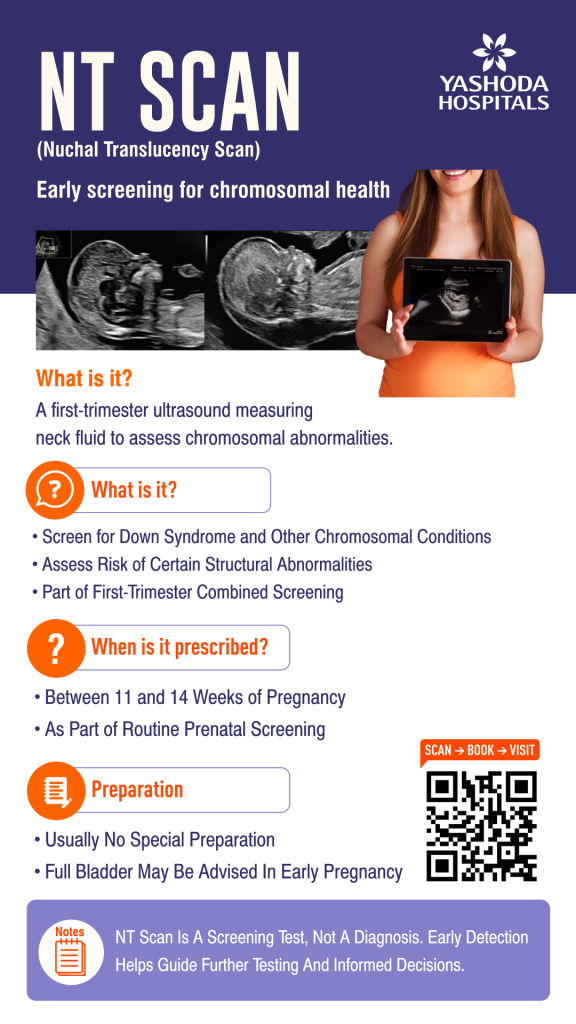
Uses of Nuchal Translucency Scanning Test:
- The nuchal translucency evaluation assists in screening for chromosomal abnormalities in the fetus.
- It is utilized to evaluate the risk of conditions like Down syndrome in a fetus, along with helping in examining the overall development of the fetus.
- The nuchal translucency test is also useful in the identification of early structural changes in the baby, and is utilized as part of first-trimester screening programs.
- It supports doctors in planning further diagnostic tests if needed, and helps in providing early reassurances to patients expecting a child.
Indications of Nuchal Translucency Test:
- The nuchal translucency evaluation is indicated in all pregnant women during the first trimester of their pregnancy.
- It is normally suggested between 11 and 14 weeks of pregnancy, and is indicated when there is a requirement for early fetal screening.
- It is suggested that women with a history of genetic or chromosomal issues, or those who are of advanced maternal age (that is, more than 35 years of age), at the time of delivering the baby.
- The nuchal translucency test is suggested when previous pregnancies have had unusual findings, and the test is indicated as part of regular prenatal care.
Preparation For Nuchal Translucency Test:
- Before undergoing nuchal translucency evaluation, no special fasting is normally needed, and the patient might be requested to have a moderately full bladder for better imaging.
- The patient should wear comfortable clothing for ease of access during the nuchal translucency evaluation.
- The patient should follow all specific instructions given by the doctor and stay relaxed before and during the nuchal translucency method.
Procedure For Nuchal Translucency Test:
- The nuchal translucency evaluation is performed using an ultrasound scan, and the patient will be asked to lie down comfortably on an examination table.
- A gel is then applied to the abdomen to improve the image quality, followed by which a transducer (ultrasound probe) is moved over the abdomen.
- The doctor measures the fluid at the back of the baby’s neck, and the images are recorded for further evaluation.
- The nuchal translucency evaluation is generally painless and normally takes about 15 minutes to 30 minutes.
Benefits of the Nuchal Translucency Test:
- The nuchal translucency test assists in the early screening of potential conditions like Down syndrome, Edward’s syndrome, and Patau syndrome.
- Nuchal transparency evaluation is a non-invasive and safe method for both mother and baby. The test also provides early insights into fetal development.
- Nuchal transparency scan supports on-time decision-making in pregnancy care; the test also helps in decreasing uncertainty during early pregnancy.
- The nuchal translucency is a widely available and easy-to-perform procedure.
Factors Influencing Results of the Nuchal Translucency Test
- The gestational age (how far along the pregnancy is) at the time of evaluation can affect outcomes.
- The baby’s position during a nuchal translucency scan might also influence the measurements, and the accuracy depends on the quality of the ultrasound equipment.
- The accuracy depends on the quality of the ultrasound equipment, along with the experience of the doctor, and healthcare professionals can also impact the outcomes of the scan.
- Maternal factors such as body weight might also affect the image clarity, along with incorrect measurement techniques, which might also change the findings of the test.
Types Of Nuchal Transparency Scans
Standalone Nuchal Transparency Scan:This involves only the ultrasound measurement of the nuchal translucency. It provides basic screening information about the fetus.
Combined First-Trimester Screening:This includes the nuchal translucency scan along with maternal blood test (Such as PAPP-A and free beta-hCG). This type offers a more complete risk evaluation.
Interpretation Of Nuchal Transparency Scan Results:
- Normal Nuchal Transparency Measurement (< 3.0 mm), which indicates a lower risk of chromosomal abnormalities.
- Borderline Nuchal Transparency Measurement (3.0 to 3.5 mm): This situation might require close observation and further examination.
- Increased Measurement (> 3.5 mm): This is associated with a higher risk of the fetus developing chromosomal or structural abnormalities.
Side Effects Of Nuchal Translucency Test:
- Mild discomfort due to pressure from the ultrasound probe on the abdomen.
- Full bladder discomfort (if required for better imaging).
- Slight uneasiness from lying in one position during the scan.
Rare Side Effects:
- No physical complications (since no needles or radiation are used).
- Very minimal skin irritation (rare, due to ultrasound gel).







 Appointment
 Second Opinion
 Live Chat
 Call
Call More
More