


Helicobacter Pylori Diagnostic Test
The Helicobacter pylori (H. pylori) evaluation is a diagnostic tool used to detect the presence of the spiral-shaped bacterium that lives in the stomach lining. This H. pylori microorganism is closely associated with many gastric conditions, as it can disturb the protective mucosal layer and lead to inflammation. Identifying its presence is vital for understanding underlying gastrointestinal disturbances and guiding appropriate clinical evaluation. The H.pylori evaluation can be performed using different methods, each planned to precisely identify the bacterium or its effects inside the body. With advances in medical diagnostics, H. pylori evaluation has become more accurate and accessible, playing a vital role in modern gastroenterology by enabling the early identification of stomach-related diseases.
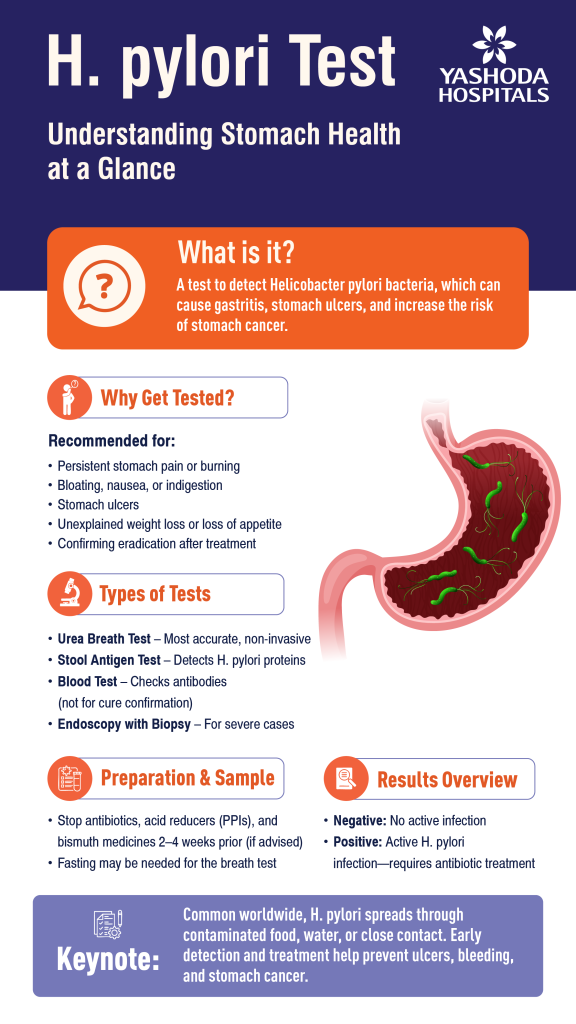
Uses of the H. pylori Test:
The H.pylori test is utilized to identify the presence of H.pylori bacteria inside your stomach, which assists in diagnosing the underlying cause of various stomach-related issues.
The H.pylori test supports doctors in identifying infections that normally affect the lining of the stomach, and helps in designing proper medical examination and further treatment.
The H.pylori evaluation is also utilized to observe the effectiveness of treatment after the infection has been managed.
Indications of H.pylori Test:
- The H.pylori test is indicated in patients who have continuous upper abdominal pain or discomfort, along with individuals who experience symptoms like bloating, nausea, or regular indigestion.
- The H.pylori test is suggested by the doctors when they suspect peptic ulcer disease.
- The test is also used in patients who have a history of gastritis or recurring stomach irritation.
- The test is also suggested for individuals who have an unexplained loss of appetite or weight loss.
- Along with all the above indications, the H. pylori test is also suggested in individuals who complain about continuous vomiting or long-standing digestive issues.
Preparation Before an H. pylori Test:
- Before an H.pylori test, the patient might be advised to stop taking antibiotics for a few weeks before the evaluation, as this can impact the test results.
- Medicines that decrease stomach acid may need to be paused for a specific period before the H.pylori test.
- Before an H.pylori evaluation, the patient is normally asked to avoid eating or drinking for a few hours prior to the test, especially in breath tests.
- The patient should inform the doctor about all current medicines they are taking, along with their medical history.
- The patient should strictly follow all the specific instructions given to them by the doctor based on the type of H.pylori test.
- The patient should avoid smoking and alcohol consumption before undergoing the H.pylori evaluation.
- The patient should wear comfortable clothing if the H.pylori test involves any clinical procedure.
Procedure of H.Pylori Test:
The procedure for the H. pylori test varies depending on the type of H.pylori test that is being performed.
Urea Breath Test:
The patient is asked to fast for a few hours before the test, which is followed by a baseline breath sample that is collected by blowing into a special bag or tube.
The patient then drinks a solution that contains urea. After a short waiting period, another breath sample is then collected.
The samples are then evaluated to identify gases that are produced by the bacterium Helicobacter pylori.
Stool Antigen Test:
The patient is given a sterile container to collect a stool sample, and then a small portion of stool is collected either at home or in the hospital.
The sample is then securely sealed and sent to the laboratory, after which it is evaluated to identify H.pylori antigens in the stool.
Blood Test (Serology):
The healthcare professional cleans the skin over a vein, and then a small needle is inserted to draw the blood sample.
The blood is then collected into a vial and sent to the laboratory. It is then tested for antibodies against H.pylori.
Endoscopy With Biopsy:
In this type, the patient is asked to fast for several hours before the procedure, followed by which a mild sedative might be given for comfort.
A thin but flexible tube is passed through the mouth into the stomach, after which the doctor evaluates the stomach lining using a camera attached to the tube.
A small tissue sample (biopsy) is taken from the stomach lining, and the sample is then sent to the laboratory to identify Helicobacter pylori.
Benefits of the H. pylori Test:
- The H.pylori test helps in early detection of the H.pylori infection, along with helping in identifying the cause of continuous stomach discomfort.
- The H. pylori test also supports the precise diagnosis of gastric diseases, along with guiding doctors in planning accurate treatment.
- H.pylori test also assists in preventing complications that are related to an untreated infection, and helps in observing how successful the treatment is.
- The test also improves overall management of digestive health and provides dependable and quick outcomes with modern testing methods.
- The H. pylori test also assists in reducing long-term stomach-related issues.
Factors Influencing Results of H. pylori Test:
- If the patient has recently used antibiotics, it can reduce the bacteria and lead to false negative H.pylori results.
- If the patient is using acid-suppressing medicines, it can affect the test accuracy of H.pylori evaluation.
- If the patient has recently taken bismuth-containing drugs, those might also interfere with the outcomes of the H. pylori test.
- If the patient has not followed fasting instructions properly before certain types of H.pylori tests (e.g., breath test).
- The results of H.pylori evaluation can also be impacted if the sample is not collected properly, mainly in the stool tests.
- If there is a delay in transporting samples to the laboratory, it can impact the results of H.pylori.
- The type of H.pylori test used can also impact the result, as different tests have varying sensitivity and specificity.
- Ongoing gastrointestinal bleeding might affect some of the test results of the H. pylori test, along with the patient’s overall health condition and immune response.
- If the patient has undergone treatment for H.pylori infection previously, it might also influence the current H.pylori test findings.
Types of H.pylori Tests:
Urea Breath Test: Is a non-invasive evaluation that identifies gases produced by H.pylori in the breath.
Stool Antigen Test: Is a non-invasive evaluation that detects H.pylori proteins (antigens) in a stool sample.
Blood Test (Serology): Is a blood evaluation that checks for antibodies against H.pylori.
Endoscopy with Biopsy: Is an invasive method where a small tissue sample is taken from the lining of the stomach and is tested for H.pylori.
Interpretation of H. pylori Results:
Positive H.pylori Result: A positive H.pylori result indicates the presence of H.pylori infection. This indicates that the bacteria are present in the stomach and might be responsible for the patient’s symptoms or underlying gastric condition.
Negative H.pylori Result: A negative H.pylori result suggests that H.pylori infection is unlikely. However, if symptoms persist, further examination or repeat evaluation might be needed.
False Negative Result: This occurs if the patient has recently taken antibiotics, proton pump inhibitors, or has not followed proper pre-H.pylori test instructions leading to decreased detection of the bacteria.
False Positive Result: In rare cases, the H.pylori test may show a positive result even though the infection is not present, based on the test method used.
Post-Treatment Interpretation: After treatment, a negative result normally confirms successful eradication, while a positive result suggests continuous infection and the need for further disease management.
Side Effects of the Helicobacter Pylori Test:
Urea Breath Test:
Mild nausea due to the test solution.
Unpleasant taste in the mouth.
Rare dizziness or bloating.
No lasting side effects.
Stool Antigen Test:
No physical side effects as such (completely non-invasive).
Minor discomfort or inconvenience.
Blood Antibody Test:
Pain or discomfort at the needle insertion site.
Bruising at the site of puncture.
Mild bleeding
Dizziness or Fainting (Quite Rare)
Very rare infection at the site.
Endoscopy With Biopsy
Sore throat after the procedure.
Mild abdominal discomfort or bloating.
Nausea from sedation.
Drowsiness or Dizziness due to sedatives.
Rare But Serious Complications:
Bleeding at the site of biopsy.
Infection due to the biopsy procedure
Perforation (tear) of the stomach lining (very rare)
Allergic reaction to the sedatives.







 Appointment
 Second Opinion
 Live Chat
 Call
Call More
More