Select Page

What is the Troponin-I Test?

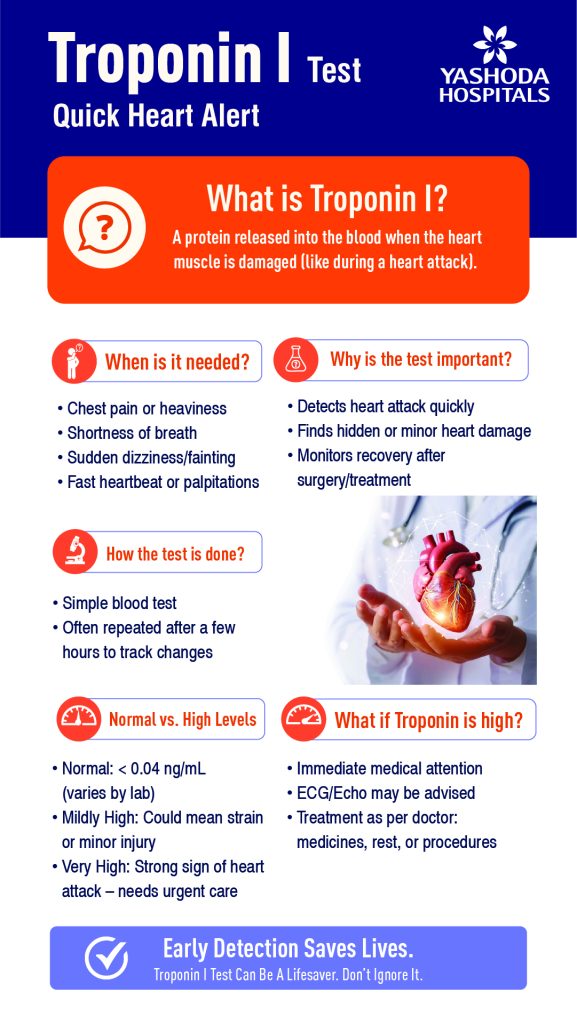
A Troponin I test is a blood test used to measure the level of cardiac troponin I, a protein released into the bloodstream when the heart muscle is damaged. It is one of the most sensitive and specific tests for diagnosing a heart attack and other conditions that cause injury to the heart muscle. Troponin I levels usually begin to rise within a few hours after heart damage and may remain elevated for several days. This test helps healthcare providers diagnose acute cardiac events, assess the extent of heart muscle injury, monitor treatment response, and guide appropriate medical management.

Uses of Troponin I Test:

  • The troponin I test is used to detect heart muscle damage.
  • The test helps to diagnose a heart attack.
  • It is used to assess the severity of cardiac injury.
  • The test helps to monitor patients with acute coronary syndrome and other heart conditions.
  • The Troponin I test also assists in guiding treatment decisions and evaluating recovery following cardiac events.

Indications of Troponin I Test:

  • A patient is advised to undergo a Troponin I test if they experience chest pain or discomfort suggestive of a heart attack.
  • The test is recommended for individuals with symptoms such as shortness of breath, dizziness, sweating, nausea, or pain radiating to the arm, jaw, neck, or back.
  • It is advised when an electrocardiogram (ECG) suggests possible heart muscle injury.
  • The test is recommended for monitoring patients with suspected acute coronary syndrome.
  • The Troponin I test may also be advised in patients with conditions that can cause heart muscle damage, such as myocarditis, heart failure, severe infections, or major cardiac surgery.

Preparation for Troponin I Test

  • The troponin I test does not require fasting.
  • The patient should inform the doctor about their symptoms, medical history, and any medications they are taking.
  • A blood sample is collected using standard blood collection procedures.
  • Multiple blood samples may be collected over several hours if serial troponin testing is required.

Procedure for Troponin I Test

  • The healthcare professional cleans the skin over the vein using an antiseptic solution.
  • A sterile needle is inserted into a vein to collect a blood sample.
  • The collected blood sample is transferred into a collection tube and sent to the laboratory.
  • The laboratory measures the level of cardiac troponin I in the blood.
  • The procedure usually takes only a few minutes, and the patient can resume normal activities unless further medical evaluation is required.

Benefits of Troponin I Test

  • The troponin I test provides early and accurate detection of heart muscle injury.
  • The test helps to confirm a heart attack.
  • It assists healthcare providers in assessing the severity of cardiac damage.
  • The test supports timely treatment and improved patient outcomes.
  • It is a safe, reliable, and widely used blood test for evaluating heart-related conditions.

Factors Influencing Results of the Troponin I Test

  • The timing of blood sample collection after symptom onset can influence test results.
  • Troponin I levels may remain elevated for several days after a heart attack.
  • Certain medical conditions, such as kidney disease, myocarditis, heart failure, and pulmonary embolism, may also increase Troponin I levels.
  • Serial testing may be required to accurately assess changes in Troponin I levels over time.
  • The results should always be interpreted along with clinical findings, ECG results, and other diagnostic investigations.

Types of Troponin I Tests

  • Troponin I Test measures cardiac troponin I, a protein released when the heart muscle is damaged. It is widely used to diagnose heart attacks and assess cardiac injury.
  • High sensitivity Troponin I (hs-cTnI) Test detects very low levels of cardiac troponin I, allowing earlier identification of heart muscle injury and improved diagnostic accuracy.
  • Troponin T Test measures cardiac troponin T, another heart-specific protein released following heart muscle damage. It is also used to diagnose heart attacks and monitor cardiac conditions.
  • High-Sensitivity Troponin T (hs-cTnT) Test measures very small amounts of troponin T in the blood, enabling early detection of heart muscle injury and risk assessment in patients with suspected acute coronary syndrome.

Interpretation of Troponin I Test Results

  • A normal Troponin I level generally indicates that there is no significant evidence of heart muscle injury.
  • An elevated Troponin I level suggests damage to the heart muscle and may indicate a heart attack or other cardiac conditions.
  • Increasing Troponin I levels on serial testing are more suggestive of an acute heart injury.
  • The test results should always be interpreted by a healthcare professional along with the patient’s symptoms, ECG findings, medical history, and other laboratory investigations.

Side Effects of Troponin I Test

  • The patient may experience mild pain or discomfort at the blood collection site.
  • Minor bleeding may occur after the blood sample is collected.
  • Some patients may feel dizziness during or after the blood withdrawal.
  • There is a very small risk of infection at the needle insertion site.
  • Most side effects are mild and resolve on their own within a short period.

Need Any Medical Help?

Talk to Our Health Care Experts!

doctor avatar

Need Any Medical Help?

Have any Questions?

Why Choose Yashoda Hospitals

Yashoda Hospitals is committed to providing world-class treatment for patients from across the globe. With the unique combination of state-of-the-art technology, intuitive care, and clinical excellence, we are the healthcare destination for thousands of international patients in India.

blank
Comprehensive Care

On the journey to good health, we understand that it is important for you to feel at home. We plan out all aspects of your trip.

blank
Expert Doctors

Experienced specialists perform non-invasive and minimally invasive surgeries to provide the best treatment for international patients.

blank
Cutting-Edge Technology

Our hospitals are equipped with advanced technology to perform a wide range of procedures and treatments.

blank
Clinical Excellence

We deliver excellence by delivering quick and efficient healthcare and through pioneering research that helps all our future.patients.

References

Frequently Asked Questions

One of the main uses of the Troponin-I Test is diagnosing heart attacks. In addition, the Troponin-I test is helpful to identify various cardiac disorders such as myocardial infarction, angina, extent and cause of heart injury. It can also explain the cause of skeletal myopathy associated with elevation of Troponin-T levels. 

The normal value of Troponin-I should be less than 40 ng/Liter. Any value above 40 ng/Liter indicates a probable heart attack and requires close monitoring. 

If you have angina pectoris, elevated Troponin-I test results indicate worsening of a pre-existing condition, which could accentuate a heart attack. Sepsis, kidney disease, cardiomyopathy, and myocarditis also increase Troponin-I levels.

You may require Troponin-I Test if you experience the below symptoms:

  • Chest pain or chest pressure
  • Fast heart rate
  • Dyspnea (shortness of breath)
  • Cold sweat
  • Excessive fatigue
  • Pain in the jaw, arm, and back

If you have stable angina, you need this test if you experience:

  • Worsening of symptoms
  • No effect of medications

A Troponin-I Test requires drawing blood from your arm. The sample then undergoes high sensitivity testing. The lab personnel insert a needle in your vein to draw blood into the specialized test tubes following sterilization of the area during the test. You might feel mild to moderate pain without any major side effects. 

Any value above 40 ng/Litre of Troponin-I in your blood is abnormal. In a few individuals, the standard value could vary to a small extent due to hereditary factors. Normal Troponin-I levels also vary depending upon sex and age. 

Troponin is a complex protein composed of 3 subtypes, troponin C, I, and T, to regulate the contraction of cardiac muscles. Troponin-I is the specific subtype of troponin protein that inhibits muscle contraction, pulls the muscle fibres, and acts as a marker in identifying heart attack and other conditions.  

The Troponin Test measures the risk of heart attack and the extent of cardiac damage. It is also useful to detect coronary artery diseases such as heart blockages that could have caused an injury to the heart muscle or blood vessels. 

In addition, an echocardiogram or electrocardiogram and imaging tests could be necessary to ascertain the heart blockage. 

Usually, your doctor would recommend undergoing a Troponin Test if you have a heart attack or are at risk. Even if you have chest pain or other heart attack symptoms, they may prescribe a Troponin Test for confirmation. 

The test is advisable for patients with stable angina to monitor the cardiac condition and detect the extent of cardiac injury.

Usually, there is no direct relation between anxiety and elevated troponin levels. However, anxiety leads to an increase in heart rate, which can cause a heart attack in rare cases. Also, anxiety-related mental stress could indirectly elevate troponin levels that could indicate stress cardiomyopathy.

A negative troponin test is not enough to rule out the possibility of heart conditions. 

People with negative troponin tests could still have heart failure symptoms or ischemic heart disease. Additional tests such as echocardiogram or electrocardiogram and imaging tests might be necessary to confirm the diagnosis.


 Book an appointment or Get a free second opinion from our experts at Yashoda Hospitals today.

Book an appointment
in 2 minutes