


TSH (Thyroid-Stimulating Hormone) Test
The Thyroid-Stimulating Hormone (TSH) evaluation is a vital diagnostic test used to assess thyroid function, which plays an important role in regulating metabolism, energy levels, and overall hormonal balance. Thyroid-Stimulating Hormone is produced by the pituitary gland and acts as a signal that controls how much thyroid hormone the thyroid gland produces. Even little changes in Thyroid-Stimulating Hormone levels can indicate underlying imbalances in the body’s endocrine system. The thyroid-stimulating hormone test is simple, widely available, and highly sensitive, making it a vital part of regular health check-ups. It assists clinicians in assessing how efficiently the thyroid is functioning and whether the body’s hormonal feedback system is functioning normally. By providing early clues about thyroid dysfunction, the Thyroid-Stimulating Hormone test supports on-time clinical evaluation and long-term observation of hormonal health, contributing to better management of overall well-being.
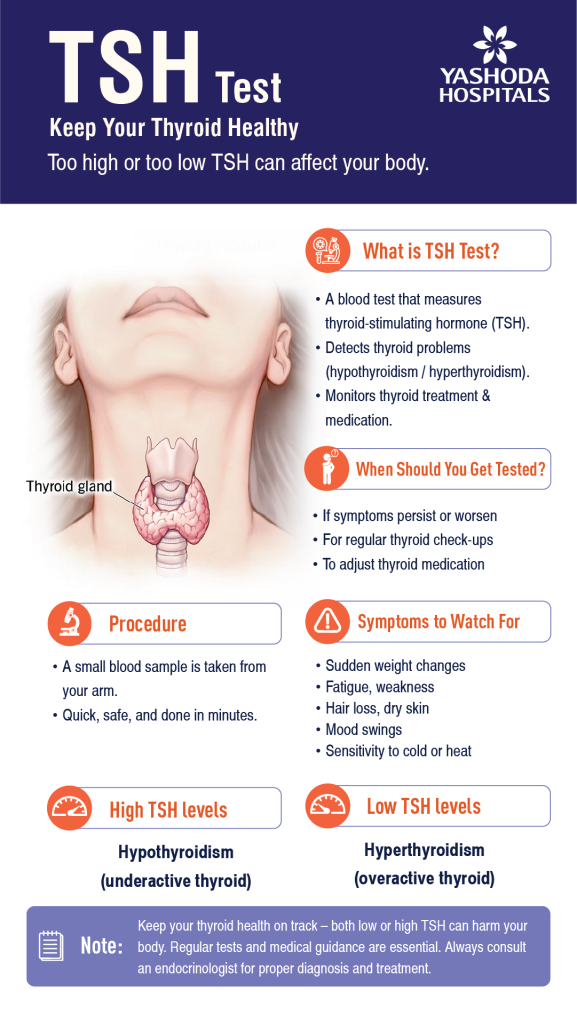
Uses Of Thyroid-Stimulating Hormone (TSH) Test
The TSH test is used to assess overall thyroid function and to detect hypothyroidism and hyperthyroidism.
- It is used to observe the effectiveness of thyroid hormone replacement treatment.
- The TSH test also helps evaluate the response to antithyroid medications.
- It is also employed to screen for thyroid dysfunction in the general population.
- It is also used to examine the pituitary gland’s regulation of thyroid hormones.
- The TSH test aids in the diagnosis of subclinical thyroid disease.
- The TSH test helps in monitoring thyroid status during pregnancy.
- Helps in assessing metabolic causes of unexplained weight changes.
Indications of the TSH Test
- The TSH test is suggested if the patient shows symptoms of fatigue, weakness, or low energy.
- It is also recommended if there is unexplained weight gain or weight loss.
A TSH test is recommended if the individual is dealing with hair loss or thinning of the hair. - If the patient is female, then a TSH test is recommended in case of palpitations or irregular heart rate.
- If the individual is sensitive to cold or is heat-intolerant.
- If the individual has swelling in the neck (suspected goiter), the TSH test might be suggested.
- If the patient has a family history of thyroid diseases.
- In newborns, the TSH test is suggested for screening for congenital thyroid diseases.
- In patients who are on long-term medications affecting thyroid function, the TSH test is used for monitoring.
- It is also used in the examination of depression or mood changes that are linked to hormonal imbalance.
- The TSH test is used for follow-up in patients with known thyroid disease, along with regular health check-ups in high-risk individuals.
Preparation Before Thyroid Stimulating Hormone (TSH) Test
- No fasting is needed before a thyroid-stimulating hormone (TSH) test (A patient can eat and drink normally unless advised otherwise by a healthcare professional).
- The patient should inform the doctor about the current medications they are taking, mainly thyroid drugs, steroids, or hormonal therapy.
- The patient should avoid taking thyroid medication just before the test (the patient should take it after the blood sample is taken if instructed).
- The patient should inform the doctor about supplements being used, especially biotin, iodine, and multivitamins.
- The patient should stop taking biotin supplements 24-48 hours before the TSH test as advised by the healthcare professional.
- The patient should be informed about recent imaging tests with contrast dye, and maintain consistent timing for repeated evaluations (preferably morning).
- The patient should avoid taking excessive stress just before TSH testing and get adequate sleep before the TSH test.
- The individual should inform the doctor if they are pregnant or planning a pregnancy.
- The patient should avoid heavy exercise just before the TSH test and stay hydrated before collecting the sample.
- The patient should follow all the specific instructions given by the healthcare provider
Procedure for Thyroid-Stimulating Hormone Test
- Before proceeding with the TSH evaluation, patient identification and test requisition are confirmed.
- Patient is seated and made comfortable in a lying position. A strap is then applied to the upper arm to locate a suitable vein.
- Skin over the site of puncture is cleaned with the help of an antiseptic solution, followed by a sterile needle that is thrust into a vein (usually in the arm).
- The required amount of blood sample is then collected into a vial/tube, and the strap is released after the blood flow is established.
- The needle is gently removed after completion of sample collection, and pressure is applied to the site of puncture to stop bleeding.
- A bandage or cotton is then placed over the site, after which the collected sample is properly labelled and sent to the laboratory.
- The sample is then evaluated using immunoassay methods to quantify the TSH levels, and Outcomes are generated and then reported to the healthcare provider.
Benefits of the TSH Test
- Early diagnosis of hypothyroidism and hyperthyroidism assists in the precise evaluation of thyroid gland function.
- Helps in timely diagnosis before symptoms become serious and supports effective treatment planning and clinical decision-making.
- Observes response to thyroid medicines and treatment by detecting subclinical (early-stage) thyroid diseases.
- Helps in the examination of unexplained weight changes and tiredness in patients with thyroid issues.
- Useful in monitoring thyroid health during pregnancy, and assists in preventing problems related to untreated thyroid imbalance.
- TSH is a simple, quick, and cost-effective evaluation that is widely available and is cost-effective.
- The TSH test provides dependable insights into the overall hormonal balance inside the human body.
Factors Influencing the Results of the TSH Test
- Age of the individual
- Gender of the individual
- Pregnency status
- Time of sample collection (diurnal variation)
- Recent illness or infection
- Stress levels
- Medicines like thyroid drugs, steroids, lithium, and amiodarone
- Biotin supplementation
- Iodine intake (excess/deficiency)
- Pituitary gland diseases
- Hypothalamic dysfunction
- Chronic systemic diseases
- Recent surgery
- Radiographic contrast exposure
- Laboratory assay variability
- Sample handling and storage conditions
- Fasting Vs Non–fasting state (minor effect)
- Smoking habits
- Alcohol consumption
- Autoimmune diseases like Hashimoto’s thyroiditis
Types of Thyroid-Stimulating Hormone Tests
Standard Thyroid Stimulating Hormone Test:Measures the level of TSH in the blood to evaluate overall thyroid function. It is the most commonly used initial screening evaluation.
High-Sensitivity TSH Test (Ultra-Sensitive TSH):Identifies very few changes in TSH levels, helping identify early or subclinical thyroid diseases with greater accuracy.
TSH With Reflex To Free T4:If TSH levels are unusual, the lab automatically measures Free T4 to provide a more detailed examination of thyroid function.
TSH with Free T3 and Free T4 Panel:Includes additional thyroid hormones to give a complete view of thyroid activity and hormonal balance.
Neonatal TSH Screening Test:Performed in newborns to diagnose congenital thyroid diseases early and prevent developmental complications.
Interpretation Of Thyroid-Stimulating Hormone (TSH) Test Results
Normal Reference Range:
Typically: 0.4 to 4.0 mlU/L (may vary slightly based on laboratory).
Low TSH Levels (< 0.4 mlU/L)
– Indicates hyperthyroidism, excess thyroid hormone production, and overmedication with thyroid hormone therapy.
Possible conditions include Graves’ disease, Thyroid nodules or toxic goiter, and Thyroiditis (early phase).
High TSH Levels (> 4.0 mlU/L)
Indicates hypothyroidism, that is, inadequate thyroid hormone production.
Possible conditions include Hashimoto’s thyroiditis, iodine deficiency, and post-thyroid surgery or radioiodine therapy.
Subclinical Thyroid Dysfunction
– Mildly elevated TSH with normal T3/T4 indicates subclinical hypothyroidism.
-Mildly low TSH with normal T3/T4 indicates subclinical hyperthyroidism.
Special Considerations
– Pregnancy: Lower reference ranges might apply.
– Elderly: Slightly higher TSH may be normal.
– Medications and Illness: Can alter results.
Important note:
TSH outcomes should always be interpreted along with free T3 and free T4 levels and clinical symptoms for accurate identification.
Side Effects of the TSH Test:
TSH testing is a simple blood test and is usually very safe, with minimal to no serious adverse effects. Nevertheless, a few minor effects might occur at the site of blood collection.
- Mild pain or discomfort at the site of injection.
- Slight bleeding after the removal of the needle.
- Swelling or tenderness in the area.
- Dizziness or lightheadedness.
- Fainting (very rare).
- Risk of infection at the site of the puncture.







 Appointment
 Second Opinion
 Live Chat
 Call
Call More
More