


C-Reactive Protein Test: Uses and Indications, Benefits, Types, Preparation, Procedure and more
What is C-reactive protein (CRP)?
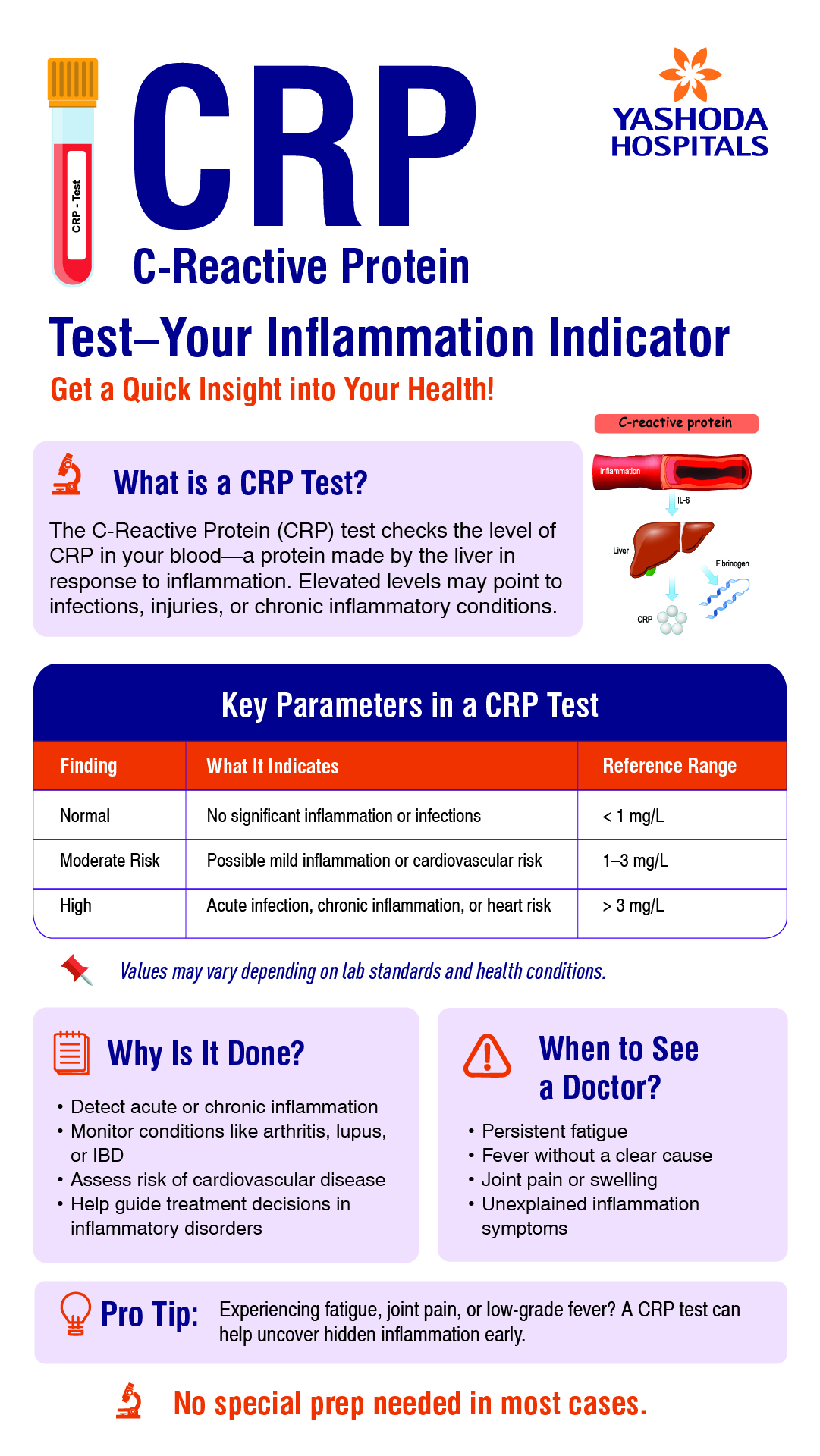
The C-reactive protein (CRP) test is a simple blood test that measures the level of C-reactive protein in the body. This protein is produced by the liver and released into the bloodstream during inflammation, which is the body’s response to infection, injury, or irritation. CRP levels can rise quickly, sometimes within hours, when tissues are affected. While the test does not diagnose a specific disease, it helps indicate the presence and extent of systemic inflammation. Higher CRP levels suggest active inflammation, while low levels usually indicate little or no inflammation. CRP results, measured in milligrams per liter (mg/L), are interpreted alongside other clinical findings to assess a patient’s overall inflammatory status.
Uses and Indications Of The C-reactive protein test
In medical practice, the uses and indications for C-reactive protein testing are closely related but have distinct meanings in different clinical contexts.
Indications (the “When” and the “Why”) are the specific reasons or signs that help a physician order the test. They describe the patient’s clinical status at the time the evaluation is proposed.
Symptoms of infection include unexplained fever, chills, tachycardia, or tachypnea.
Suspected inflammatory conditions may present with joint pain, swelling, or unexplained fatigue.
Post-surgical monitoring includes assessing for early signs of infection or complications after completion of the procedure.
Risk evaluation includes testing a patient for a specific cardiovascular disease, primarily using high-sensitivity CRP (hs-CRP).
Uses (the “How” and “What For”) refer to the broader purposes or functions for which the C-reactive protein test is used in the management of a patient’s care. It describes what the C-reactive protein test results help clinicians achieve.
Detection: Identification of systemic inflammation in the body.
Diagnosis support: Helping the physician differentiate between bacterial and viral infections (bacterial infections are usually associated with elevated C-reactive protein levels).
Assessing the treatment: Evaluating whether a treatment (e.g., antibodies or anti-inflammatory agents) is effective by observing whether C-reactive protein test results decline over time.
Preparation for C-reactive protein test:
The patient should avoid strenuous exercise, such as intense weight training or long-distance running, before undergoing the C-reactive protein test. Intensive physical activity can transiently increase C-reactive protein levels.
Patients should inform healthcare professionals of all medications and supplements taken, particularly anti-inflammatory drugs, statins, hormone replacement therapy, birth control pills, and magnesium supplements. They should also postpone the test if they have a temporary illness, such as a cold or flu, or a recent injury, as these conditions can falsely elevate C-reactive protein levels and affect the results.
Fasting requirements for the C-reactive protein test:
Standard CRP evaluation does not require fasting, whereas the high-sensitivity C-reactive protein (hs-CRP) test requires a 9-12-hour fast because it is performed alongside a fasting lipid panel.
It is recommended to drink plenty of water before a C‑reactive protein test to facilitate blood collection and to avoid smoking, as smoking may affect the results.
Procedure of the C-reactive protein test:
A suitable vein, usually in the inner elbow or the back of the hand, is identified, and the area is cleaned with an antiseptic. An elastic band is tied around the upper arm to make the vein more visible, and a sterile needle is inserted. A small amount of blood is then collected into a sterile vial or test tube. Once the sample is obtained, the needle is removed, pressure is applied with cotton or gauze to control bleeding, and a small bandage is applied.
After the C-reactive protein test results are sent to the lab, they are analyzed by using one of the following methods like
- Immunoassay/Immunoturbidometry: An automated test in which antibodies bind to C-reactive protein (CRP) in the sample, and the resulting turbidity is measured to determine CRP concentration.
- Latex Agglutination: A manual technique in which latex particles coated with anti-C-reactive protein are mixed with the patient’s serum. If C-reactive protein is present, clumping (agglutination) is visible within two minutes.
- Nephelometry is a technique that measures light scattering to quantify low concentrations of C-reactive protein (CRP), which is commonly used in the high-sensitivity C-reactive protein (hs-CRP) test.
Results of the C-reactive protein test are usually available within 48 hours. A standard C-reactive protein level is considered to be normal if it is below 10mg/L. As discussed, elevated C-reactive protein levels indicate inflammation, which can result from infection, injury, or a chronic condition such as rheumatoid arthritis.
Benefits of the C-reactive protein test:
- Early identification of any infection.
- Heart disease risk evaluation
- Monitoring chronic (long-term) disease conditions
- Post-surgical tracking
- Differentiating between two infections
Factors Influencing C-reactive protein test results:
Multiple factors influence C-reactive protein results because the liver releases this protein in response to inflammation, whether acute or chronic. Factors that may influence C-reactive protein (CRP) results include:
Infections such as bacterial, viral, or fungal illnesses, as well as recent injuries or post-surgical recovery.
- Chronic inflammatory conditions, including autoimmune diseases like Rheumatoid Arthritis, Lupus, Inflammatory Bowel Disease, Diabetes, and Hypertension.
- Lifestyle factors such as obesity, excess body fat, smoking, and a sedentary routine.
- Physical activity patterns, where intense exercise immediately before testing may temporarily affect results.
- Dietary habits, especially diets high in trans fats or refined sugars, while anti-inflammatory foods like fruits, vegetables, fiber, and fish oil may support a healthier balance of inflammation.
- Chronic stress and poor sleep quality are linked to systemic inflammation.
Types of C-reactive protein test:
The traditional C-reactive protein test and the high-sensitivity C-reactive protein test (hs-CRP) are two main categories used in clinical medicine. Although they measure the same protein, their purposes differ.
The standard C-reactive protein test is used to diagnose significant active inflammation associated with short- or long-term conditions. This test type is used to identify and monitor serious bacterial or viral infections, autoimmune diseases such as rheumatoid arthritis and lupus, and postoperative recovery. This type of C-reactive protein test typically measures levels ranging from approximately 5 mg/L to several hundred mg/L. Levels above 10 mg/L indicate an underlying inflammation.
The high-sensitivity C-reactive protein test is a more accurate version of the standard C-reactive protein test, able to detect even low levels that the standard version might miss.
This test is especially used to evaluate the long-term risk of cardiovascular disease in otherwise healthy individuals.
This test detects fine concentration in the range of 0.3 to 10mg/L.
Cardiac risk levels:
- Low risk: Less than 1.0 mg/L
- Average risk: 1.0 to 3.0 mg/L
- Higher risk: Greater than 3.0 mg/L
Comparison of the standard C-reactive protein test and high-standard C-reactive protein test
| Feature | Standard C-reactive protein test | High-standard C-reactive protein test |
|---|---|---|
| Sensitivity | Measures moderate to high levels | Measures very low, subtle levels |
| Primary Use | Infection, Autoimmune flares | Heart disease/stroke risk |
| Normal Range | Typically < 10mg/L | Risk-based (Eg, <1mg/L is low risk) |
A few other specialized variations and terms one may encounter, depending on laboratory or medical context, are:
- Wide-range C-reactive protein test (Wr-CRP): This is a new, all-in-one evaluation that combines the capabilities of both highly sensitive and standard C-reactive protein tests. It can accurately measure very low and very high levels of C-reactive protein in a single run, making it more cost-effective for laboratories.
- Cardiac C-reactive protein test (cCRP): This is primarily a high-sensitivity C-reactive protein test used to evaluate cardiovascular risk. Although the technology is the same as that used in the hs-C-reactive protein test, the cardiac label ensures compliance with specific regulatory standards for cardiac health screening.
- Point-of-care C-reactive protein test: These rapid tests are used in clinics and emergency departments to provide results within minutes rather than days. They are often used to determine whether the infection is bacterial or viral, thereby helping physicians decide whether antibiotics are needed.
- Ultra-sensitive C-reactive protein (us-C-reactive protein test): In some research settings, ultra-sensitive is used interchangeably with high-sensitivity C-reactive protein test.
Side Effects Of C-reactive Protein Test:
A C-reactive protein test is a standard, low-risk blood draw that typically does not cause serious side effects because it requires only needle insertion. Any discomfort is usually mild and temporary.
Most individuals only experience minor symptoms at the site where blood is drawn, which includes
- Slight pain or stinging during needle insertion or removal.
- Tenderness or throbbing in the arm immediately following the procedure.
- Mild bruising or swelling around the site of puncture, which normally resolves in a few days.
- Minor bleeding that stops once pressure is applied.







 Appointment
 Second Opinion
 Live Chat
 Call
Call More
More