


Creatinine Diagnostic Test
A creatinine diagnostic evaluation is a frequently performed laboratory test utilized to calculate the level of creatinine in the blood or urine. Creatinine is an unwanted product generated from the normal breakdown of creatine, a substance found in human muscles that helps in producing energy. Creatine is released into the bloodstream at a relatively constant rate and is filtered out by the kidneys. Because of this continuous production and elimination process, the levels of creatinine provide very important insight into the body’s metabolic balance. Creatinine diagnostic evaluation is simple, widely available, and is mostly included as part of a regular health check-up or a complete metabolic panel. It is considered a standard criterion in clinical practice due to its reliability and ease of measurement. Differences in creatinine levels can indicate changes in physiological processes, making it a vital component of laboratory testing in both outpatient and inpatient healthcare settings.
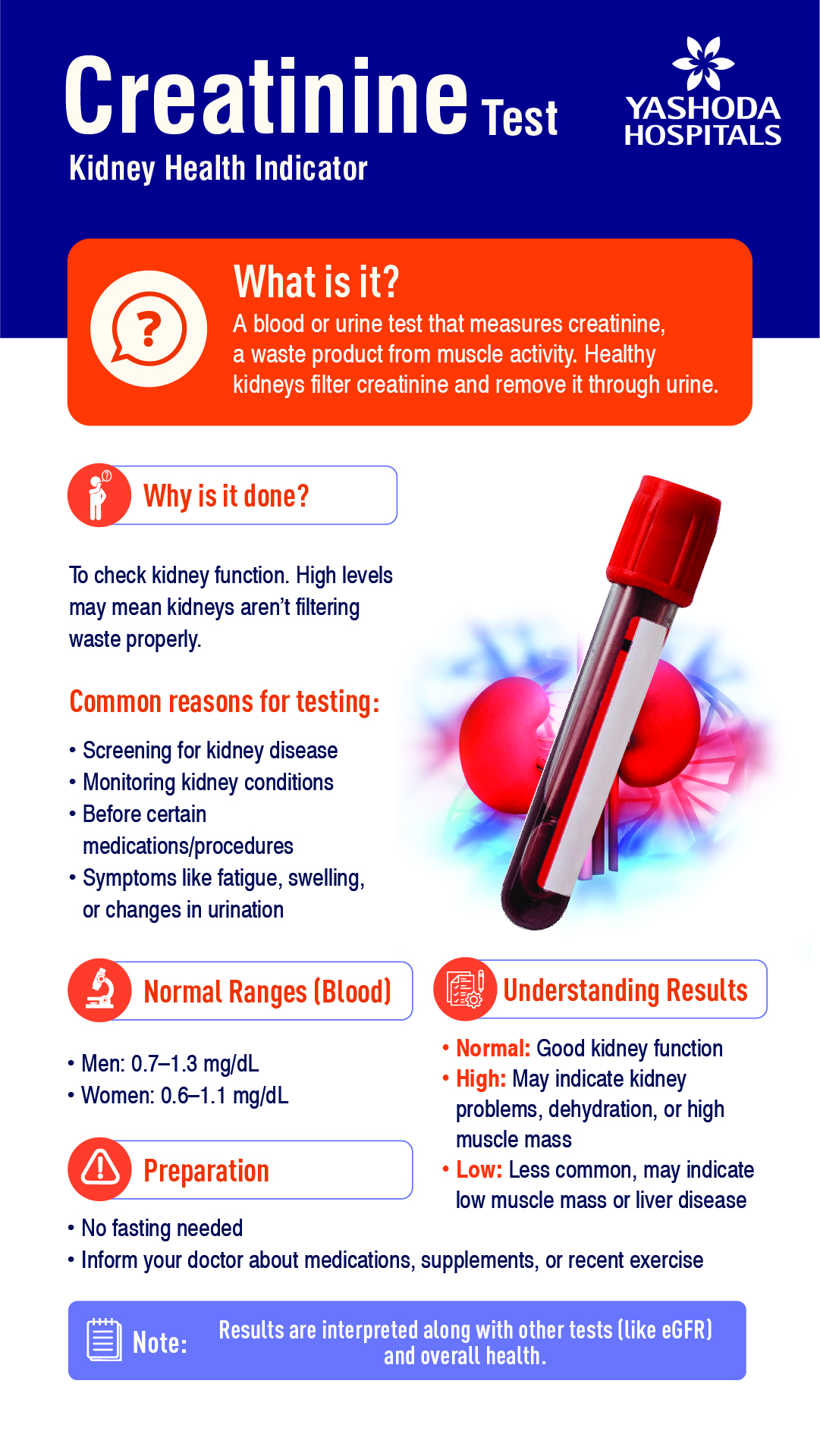
Uses of the creatinine diagnostic test
- To calculate the level of creatinine in blood or urine as a sign of how effective the kidney filtration is.
- To examine the overall kidney function and diagnose any decline in kidney performance.
- Creatinine evaluation is vital for kidney specialists in observing the progression of kidney-related conditions over time.
- To examine the effectiveness of ongoing treatment for kidney diseases.
- To measure the estimated glomerular filtration rate (eGFR) for improved evaluation of renal function.
- To check kidney functioning before beginning the course of certain medicines that might affect the performance of the kidneys.
- Creatinine examination helps in observing patients undergoing therapy ike dialysis or after a kidney transplant.
- The creatinine test is also utilized to evaluate hydration status and its impact on kidney functioning.
- The creatinine test is also utilized to support regular health screenings and complete metabolic tests.
Indications Of Creatinine Diagnostic Test
- If the patient has signs that suggest possible kidney dysfunction such as swelling, continuous tiredness, or decreased urine output.
- Creatinine evaluation is indicated in patients with long-term conditions like diabetes or hypertension that increase the risk of kidney ailments.
- The creatinine test is also done before and after treatment with medicines that are normally harmful to the kidneys ( for example, some antibiotics and chemotherapy).
- The creatinine evaluation is also done during regular health check-ups, mainly in high-risk individuals or elderly patients.
- The creatinine examination is also done when other kidney diagnostic tests show abnormal results, especially in tests like blood urea nitrogen (BUN).
- Creatinine evaluation is also done in cases where it is suspected that the patient is dealing with short-term kidney injury or long-term kidney disease.
- It is also indicated before an individual undergoes any major surgery to examine the baseline kidney functioning.
- It is also done to observe patients with urinary tract obstruction or infections that affect the functioning of the kidneys.
- A creatinine test is also indicated in the follow-up of patients with a history of kidney diseases or those who require a kidney transplant.
- The creatinine test is also done when there is an unexplained fluid imbalance or electrolyte disturbance.
Preparation For Creatinine Diagnostic Evaluation
- Before the creatinine diagnostic test, fasting is normally not needed, but some doctors might suggest avoiding eating for some hours based on other evaluations that are ordered along with the creatinine test.
- The patient is advised to be properly hydrated before the creatinine test, as dehydration can affect the levels of creatinine.
- The patient should avoid heavy intake of red meat or foods high in protein for at least 24 hours before the creatinine examination, as it may raise creatinine levels in the short term.
- The patient should avoid any stressful exercise a day before the creatinine test, since heavy physical activity can elevate creatinine due to muscle breakdown.
- The patient should inform the doctor about all the medicines and supplements that they are taking, mainly those that might impact the functioning of the kidney. (eg, some antibiotics and NSAIDs).
- The patient should strictly avoid creatinine supplements before the evaluation, as this can lead to false elevation in the test outcomes.
- For urine creatinine evaluations (especially 24-hour collection), the patient should follow instructions carefully regarding the collection timing and storage.
- The patient should avoid alcohol before the creatinine diagnostic evaluation, as this might affect hydration as well as the functioning of the kidney.
- The patient is advised to wear comfortable clothing if they are visiting a lab for blood sample collection for a creatinine test.
- The patient should follow every specific instruction provided by the healthcare provider or diagnostic center for precise outcomes.
Procedure For Creatinine Diagnostic Evaluation
- The creatinine examination might be performed by utilizing a blood sample, a urine sample, or both, based on the doctor’s suggestion.
- If the creatinine evaluation is done by drawing blood, then the patient is asked to take a seat comfortably, and the skin above the vein is cleaned with an antiseptic.
- A sterile needle is then thrust into the vein to draw a small amount of blood into a collection tube.
- The needle is then removed, and a little pressure is applied to the site to stop any kind of the bleeding.
- The collected sample of blood is then labeled and sent for evaluation to the laboratory.
- For a spot creatinine urine evaluation, the patient is asked to provide a urine sample in a sterile container.
- For a 24-hour urine creatinine evaluation, the patient collects all the urine passed over a full 24-hour period in the provided container.
- The creatinine test sample is stored as instructed (mostly in a cool place) during the collection period.
- After completion, the urine sample is submitted to the laboratory for examination.
- Inside the laboratory, creatinine levels are calculated using standardized biochemical methods.
- Outcomes are recorded and reported, mostly along with reference ranges for interpretation.
Benefits of the Creatinine Diagnostic Test:
- Allows advanced detection of changes in the kidney function, allowing on time medical attention.
- Creatinine diagnostic evaluation is a dependable marker in examining how efficiently the kidneys are filtering the unwanted products.
- The test assists in the regular monitoring of kidney health in patients with existing medical conditions.
- Helps healthcare providers in adjusting treatment plans based on the performance of the kidney.
- Supports estimation of glomerular filtration rate (eGFR) for more accurate examination of renal functioning.
- The test is handy in tracking patients’ recovery and disease progression, especially in patients with kidney-related diseases.
- Takes part in exhibiting a vital role in preventive health screenings and regular medical check-ups.
- Assists in diagnosing potential complications in conditions such as diabetes and high blood pressure.
- The creatinine test is quick, simple, and minimally invasive with a fast turnaround time, and is widely accessible across diagnostic laboratories and hospitals.
- The creatinine diagnostic test is cost-effective and suitable for repeated observations whenever required.
- The test contributes to overall health evaluation when included in broader diagnostic panels.
Factors Influencing Creatinine Test Results
- Age of the individual: Older patients might have low levels of creatinine due to decreased muscle mass.
- Gender: Males usually have higher levels of creatinine in comparison to females because males have higher muscle mass.
- Muscle mass: Individuals with greater muscle mass, like athletes, tend to have higher baseline creatinine levels.
- Diet: Individuals with excessive intake of red meat or foods that are rich in protein, in the short term, can increase the levels of creatinine.
- Hydration Status: Dehydrated individuals can experience increased creatinine levels, while sufficient hydration might assist in maintaining normal values.
- Physical Activity: Heavy or strain-causing physical activity can increase creatinine due to the breakdown of muscles.
- Medicines: Some drugs like antibiotics, NSAIDs, and chemotherapy agents can affect levels of creatinine or the functioning of the kidney.
- Creatine supplements: If an individual utilizes creatine supplements, it may artificially raise levels and cause misinterpretation of results.
- Kidney Function: Any disturbance in kidney filtration directly impacts the levels of creatinine in an individual.
- Pregnancy: The levels of creatinine might decrease during pregnancy due to increased filtration by the kidneys.
- Chronic Conditions: Long-term diseases like diabetes, hypertension, and cardiovascular diseases can influence levels of creatinine as well as the functioning of the kidneys.
- Liver Function: Serious liver diseases can decrease creatinine production.
- Recent Illness or Injury: Conditions that cause damage to muscles or stress can alter levels of creatinine.
- Laboratory Variations: Differences in testing methods or equipment might slightly affect outcomes.
Types Of Creatinine Test:
- Serum Creatinine Test: Calculates levels of creatinine in blood, and is the most frequently utilized test to evaluate kidney function.
- Plasma Creatinine Test: Same as serum testing but utilizes plasma; outcomes are nearly identical, and it is utilized in certain lab settings.
- Urine Creatinine Test: Calculates creatinine concentration in a single urine sample to examine kidney functioning or normalize other urine markers.
- Early Morning Urine Creatinine Test: Utilizes the first urine of the day for more stable and less variable outcomes.
- Timed Urine Creatinine Test: Collects Urine over a specific duration (eg, 12 hours) to evaluate creatinine excretion.
- 24-Hour Urine Creatinine Test: Measures total creatinine excreted in urine over 24 hours, providing a complete evaluation.
- Creatinine Clearance Test (CrCI): Compares creatinine levels in blood and urine to evaluate how efficiently the kidneys filter waste.
- Estimated Glomerular Filtration Rate (eGFR): A measured value based on serum creatinine and patient factors to estimate overall kidney filtration capacity.
- Blood Urea Nitrogen (BUN)/Creatinine Ratio: Examines the balance between urea and creatinine to help evaluate underlying causes of kidney issues.
- Urine Albumin to Creatinine Ratio (ACR): Identifies even small amounts of albumin in urine, assisting in diagnosing early damage to the kidneys.
- Protein to Creatinine Ratio (PCR): Calculates protein loss in urine relative to creatinine, useful in the examination of kidney disease.
- Cystatin C With Creatinine Test: Combines two markers to improve precision in evaluating kidney function, mainly in borderline cases.
- Creatinine-Based Renal Panel: Includes Creatinine along with other parameters like electrolytes for broader kidney health evaluation.
- Point-of-Care Creatinine Test: Provides quick results using portable devices, commonly utilized in emergency or outpatient settings.
Interpretation Of Creatinine Diagnostic Test
Creatinine levels are interpreted based on blood (serum) values, urine values, and calculated parameters like eGFR. Results must always be correlated with age, sex, muscle mass, and clinical condition.
Serum Creatinine – Reference Ranges
Adult Males: 0.7 to 1.3 mg/dL
Adult females: 0.6 to 1.1 mg/dL
Children: 0.3 to 0.7 mg/dL
Interpretation based on Serum Creatinine Levels
- Normal – within reference range (0.7 to 1.3 mg/dL) – indicates normal kidney filtration.
- Mild elevation (= 1.3 to 2.0 mg/dL): May suggest early kidney dysfunction, dehydration, or high protein intake.
- Moderate elevation ( = 2.0 to 5.0 mg/dL): indicates significant impairment in kidney function.
- Severe Elevation (> 5.0 mg/dL): suggests serious kidney damage or even a possible kidney failure.
Low Levels Of Creatinine
Is observed in reduced muscle mass, malnutrition, aging, or serious liver disease.
Normally not a primary issue, but it is examined in a clinical context.
eGFR (Estimated Glomerular Filtration Rate) Interpretation
≥ 90 mL/min/1.73 m2: Normal Kidney Function
60-89: Mild decrease
30-59: Moderate decrease (Chronic kidney disease stage 3)
15-29: Severe decrease
<15: Kidney failure (end-stage renal disease)
Creatinine Clearance (CrCl):
Normal: 90 to 140 mL/min (men), 80-125 mL/min (women)
Decreased values indicate decreased kidney filtration capacity.
Urine Creatinine (24-hour):
Men: 955 – 2936 mg/day
Women: 601 – 1689 mg/day
Low values: Impaired kidney function or decreased muscle mass.
High Values: High muscle mass or excessive protein intake.
Bun/Creatinine Ratio Interpretation:
Normal: 10:1 to 20:1
High ratio (>20:1): Dehydration, gastrointestinal bleeding.
Low ratio (< 10:1): liver disease or malnutrition.
Albumin-to-Creatinine Ratio (ACR)
<30 mg/g: Normal
30 to 300 mg/g: Microalbuminuria (early kidney damage).
> 300 mg/gL: Macroalbuminuria (advanced kidney damage).
Important Notes:
- A single abnormal creatinine test value does not confirm the presence of the disease; repeated evaluation is needed.
- Creatinine levels rise only after significant kidney damage, so early disease may show normal values.
- Results should always be interpreted along with clinical symptoms and other tests like urea, electrolytes, and imaging.
- Factors like diet, hydration, and medicines must be considered before diagnosis.
Side Effects of the Blood Creatinine Test
- Mild pain or discomfort at the needle insertion site.
- Bruising (hematoma) at the site of puncture.
- Slight bleeding after removing the needle.
- Dizziness or lightheadedness, mainly in sensitive patients.
- Rare infection at the puncture site if not properly cleaned.
- Fainting (Vasovagal response) in some patients.
Side Effects of the Urine Creatinine Test
- There are no physical side effects for this test as it’s a non-invasive technique.
- Minor disadvantage or discomfort during 24-hour urine collection.
- Risk of inaccurate results if collection instructions are not followed properly.







 Appointment
 Second Opinion
 Live Chat
 Call
Call More
More