


PCV (Packed Cell Volume) Test
Packed cell volume (PCV), also termed hematocrit, is a basic blood evaluation that tells us how much of our blood is made up of red blood cells. It is given as a percentage depicting the part of the blood that is cells, in comparison with the liquid part called plasma. In healthy adults, red blood cells make up about 40% to 50% of the blood, but this can vary based on age, sex, and the condition of the body. The idea of packed cell volume began when doctors wanted a simple way to check blood health, mainly for issues like anemia and blood donations. PCV evaluation became widely used after the discovery of the centrifuge machine that spins blood rapidly to separate red blood cells from plasma. Today, PCV is still a vital part of regular blood evaluation done in hospitals, clinics, and research labs around the world. PCV test depicts how well blood can carry oxygen, because red blood cells contain hemoglobin, which transports oxygen to your body’s tissues. PCV test follows international standards, including guidelines from WHO, and mostly uses quick “microhematocrit” methods in places with limited resources. Modern blood analyzers now include PCV in large test panels, making diagnosis quicker and more organized.
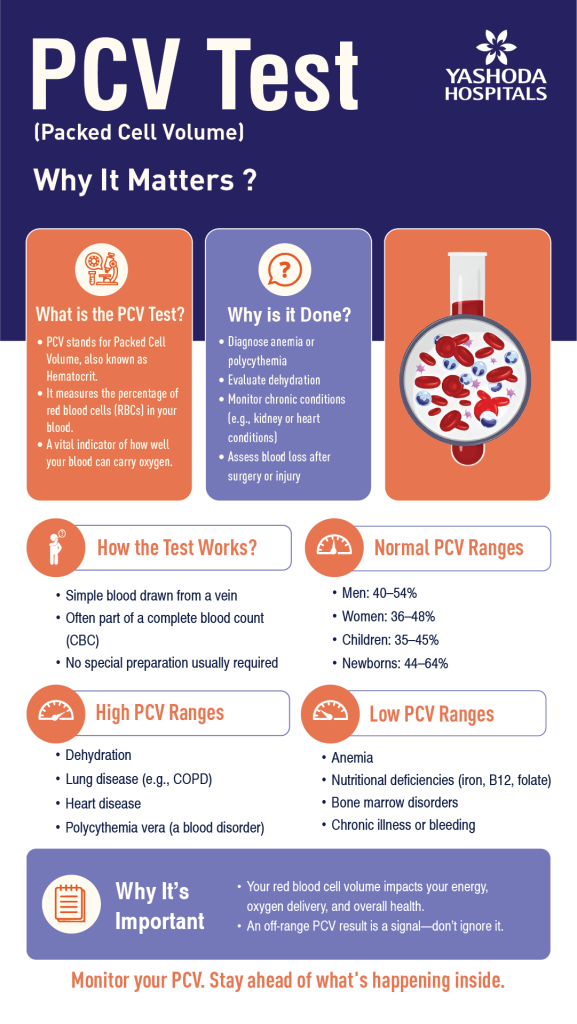
Uses of the Packed Cell Volume (PCV) Test
- To measure the amount of red blood cells in the blood and therefore evaluate the overall blood health.
- To help examine how well the blood can carry oxygen to the tissues in the body.
- To observe the progression of long-term diseases such as kidney disease, heart disease, lung disease, or blood diseases.
- To inspect the effect of treatments like blood transfusions, iron therapy, or chemotherapy on red blood cell levels.
- To assist in the pre-surgery examination of blood, and to determine how fit an individual is to undergo surgery.
Indications of the Packed Cell Volume (PCV) Test
- PCV test is recommended by a doctor if the individual shows signs of anemia, such as tiredness, weakness, pale skin, dizziness, or shortness of breath.
- PCV test is also suggested if symptoms of dehydration, like dry mouth, reduced urine, dizziness, and sunken eyes, are also observed in an individual.
- PCV test is suggested if an individual is suspected of having polycythemia or other conditions that cause abnormally high red blood cell counts.
- PCV test is also suggested if the patient has to undergo regular check-ups or follow-up in patients with known blood diseases, kidney diseases, or in individuals with long-term lung or heart diseases.
- PCV test is also recommended if complete blood count (CBC) evaluation outcomes are abnormal, or there are unexplained changes in energy levels and general health of the individual.
Preparation of the Patient Before Packed Cell Volume (PCV) Test
- The patient should confirm with their doctor, any healthcare professional, or lab if fasting is required before the PCV test. Normally, no fasting is needed for just a PCV test, but fasting may be recommended if other evaluations or tests are done together.
- The patients should stay well hydrated the day before and on the day of the examination with plain water, as dehydration can impact PCV results.
- The patient is advised to avoid alcohol, intense exercise, and heavy physical stress the night before the PCV test, since these activities in the short term can affect red blood cell levels and blood volume.
- The patient should inform the doctor or healthcare professional about all the medicines, supplements, or herbal products that they are taking (mainly diuretics, blood thinners, or medicines that have an impact on the blood or kidneys). This might influence PCV results.
- The patient should also share a complete medical history that includes anemia, kidney disease, heart disease, lung disease, or regular blood transfusions with the doctor, as this can also change PCV interpretation.
- On the day of PCV evaluation, the patient should wear loose-fitting clothing with rolled-up sleeves for easy access to the vein in the arm or hand.
- The patient should try to remain calm and relaxed; severe anxiety or stress can cause mild differences in blood parameters and make access to the vein more difficult.
- The patient is then asked to sit or lie down for a few minutes before blood sample collection to stabilize blood pressure and flow.
Procedure of Packed Cell Volume (PCV) Test:
- The patient sits or lies down comfortably, and the area (usually the inside of the elbow) is then cleaned with the help of an antiseptic.
- A well-trained healthcare professional then ties a strap above the site to make the vein more visible and then thrusts a sterile needle to draw a small amount of venous blood.
- The blood sample is then collected into a tube that might contain an anticoagulant (like EDTA) to prevent clotting.
- In the laboratory, the blood is transferred into a special capillary tube (for the microhematocrit method) or processed in an automated analyzer.
- The capillary tube is sealed at one end and then placed inside a centrifuge, which spins the blood sample at high speed for a set time.
- Post-centrifugation process, red blood cells settle at the bottom, plasma remains on top, and a buffy coat (White cells and platelets) sits in between.
- The length of the packed red blood cell column is then measured against the total blood column utilizing a scale or reader, and PCV is interpreted as a percentage.
- In automatic systems, the machine itself calculates PCV electronically from the same blood sample utilized for other complete blood count parameters and prints the outcomes.
Benefits of Packed Cell Volume (PCV) Test:
- Assists in diagnosing anemia quickly by determining if the red blood cell percentage is lower than normal.
- Identifies dehydration or excessive fluid loss when the levels of PCV are higher than expected.
- Assists in diagnosing polycythemia (too many red blood cells), which can increase the risk of blood clots and other complications.
- Examines how well the blood can carry oxygen to tissues, providing insight into the overall blood health.
- Assists in observing the progression of long-term diseases that affect red blood cell production.
Tracks the response to treatment of disease conditions like iron therapy, blood transfusions, or chemotherapy, to observe if the levels of red blood cells are improving. - Gives a simple, quick, and inexpensive evaluation that can be included in a panel of regular blood tests or pre-surgical examination.
Factors Influencing Results of Packed Cell Volume (PCV) Test
- If the individual is dehydrated, the condition can falsely raise PCV levels because less plasma (fluid part of blood) makes red blood cells more concentrated. In contrast, over-hydration can lower it.
- In pregnant women, increased plasma volume in pregnancy dilutes red blood cells, often decreasing PCV levels even when the individual is otherwise healthy.
- People living at high altitudes have an increased amount of red blood cell production due to the body adapting to lower levels of oxygen. This also can lead to higher PCV.
- Intense exercise and recent blood loss (that includes blood donation) can decrease PCV levels in the short term.
- Drugs like erythropoietin, steroids, diuretics, or hormonal imbalances (eg, hypothyroidism) can cause variations in red blood cell production and PCV.
- Blood diseases like polycythemia, anemia, hemolytic anemia, or issues with bone marrow can naturally cause fluctuations in PCV levels.
- Technical factors like improper sample mixing, long-term strapping, delays in processing, or incorrect centrifugation settings can give false high or low PCV outcomes.
Different Methods Or Techniques To Measure PCV
- There are no different types of PCV tests in the context of separate diseases. But PCV is measured by many methods or techniques, which are the main types of PCV test in practice.
- Manual microhematocrit (Capillary tube) method: A small blood sample is drawn from a finger prick or vein and filled into a capillary tube. The tube is sealed and spun in a microcentrifuge, and PCV is interpreted as the percentage of packed red cells using a scale or reader card.
- Macrohematocrit (Wintrobe) method: Blood is collected in a Wintrobe tube, an anticoagulated glass tube with calibrated markings. Post centrifugation, the height of the packed red-cell column is directly read off the tube as PCV.
Automated (Instrument-based) PCV technique: Modern hematology analyzers measure PCV electronically from the same blood sample used for complete blood count (CBC) evaluation. PCV is derived from red blood cell count and mean corpuscular volume. - Point-of-care (POC) PCV testing is used in field settings, clinics, or bedside devices, where a drop of blood is placed inside a small cartridge or strip and read by a compact analyzer. Gives a quick PCV estimate, useful for quick screening and emergencies.
- In regular practice, PCV test normally refers to either manual microhematocrit or automated analyzer-based method; the others are mainly utilized in specific labs or teaching settings
Interpretation of Packed Cell Volume (PCV) Results
Normal Packed Cell Volume (PCV) Results
Men – About 40% to 54%
Women – About 36% to 48% (some labs use 35% to 45% or 37% to 47%)
Children (roughly up to 15 years): 30% to 44% (Variations can occur according to age).
Red-cell mass and blood volume are usually in balance. But still be read with symptoms and other tests (hemoglobin, RBC count, and Mean corpuscular volume test).
Low Packed Cell Volume (PCV) Results (Below normal level, indicating anemia or dilution)
Men – Usually below 38% to 40%
Women – Usually below 35% to 36%
Children – It varies by age, and often below 30% in older children is considered low
This is interpreted as anemia, or decreased red-cell mass, which may be due to iron deficiency, long-term disease, blood loss, bone-marrow issues, or hemolysis.
This can also occur in case of overhydration or serious fluid overload, where plasma volume is high relative to red cells.
High Packed Cell Volume (PCV) Results (Above Normal, Suggestive of Polycythemia or Dehydration)
Men – Often above 52% to 54%
Women – often above 48% to 50%
True polycythemia is increased red-blood cell production.
Relative polycythemia is usually due to dehydration, burns, vomiting, diarrhea, or the use of diuretics. Where plasma volume is decreased, but total red blood cells might be normal.
The healthcare professionals should always interpret packed cell volume in context with the patient’s age, sex, altitude, hydration, and other complete blood count parameters, and confirm abnormal values with repeated evaluation and clinical tests.
Side Effects of the Packed Cell Volume Diagnostic Test
- Slight pain or discomfort at the site of needle insertion.
- Slight bruising around the puncture area.
- Minor bleeding after blood sample collection.
- Dizziness or lightheadedness in some individuals.
- Rare chances of infection at the site of injection.
- Occasional fainting in highly sensitive individuals.
- Small hematoma (blood collection under the skin).







 Appointment
 Second Opinion
 Live Chat
 Call
Call More
More