


HBsAg Diagnostic Test
The HBsAg (Hepatitis B Surface Antigen) examination is a blood evaluation utilized to identify the presence of a particular protein found on the surface of the Hepatitis B virus. This antigen appears in the bloodstream during active infection and serves as a key marker for detecting the virus. The evaluation is widely used in clinical settings due to its precision and reliability in identifying Hepatitis B, even in early stages. A small blood sample is collected and evaluated using modern laboratory techniques, such as immunoassays. The identification of HBsAg implies that the virus is present inside the body, while HBsAg absence suggests no current infection. This evaluation is routinely included in health check-ups and is a vital component of diagnostic protocols in healthcare settings. HBsAg testing plays a significant role in the early identification of Hepatitis infection, supporting effective disease monitoring and contributing to overall public health management efforts.
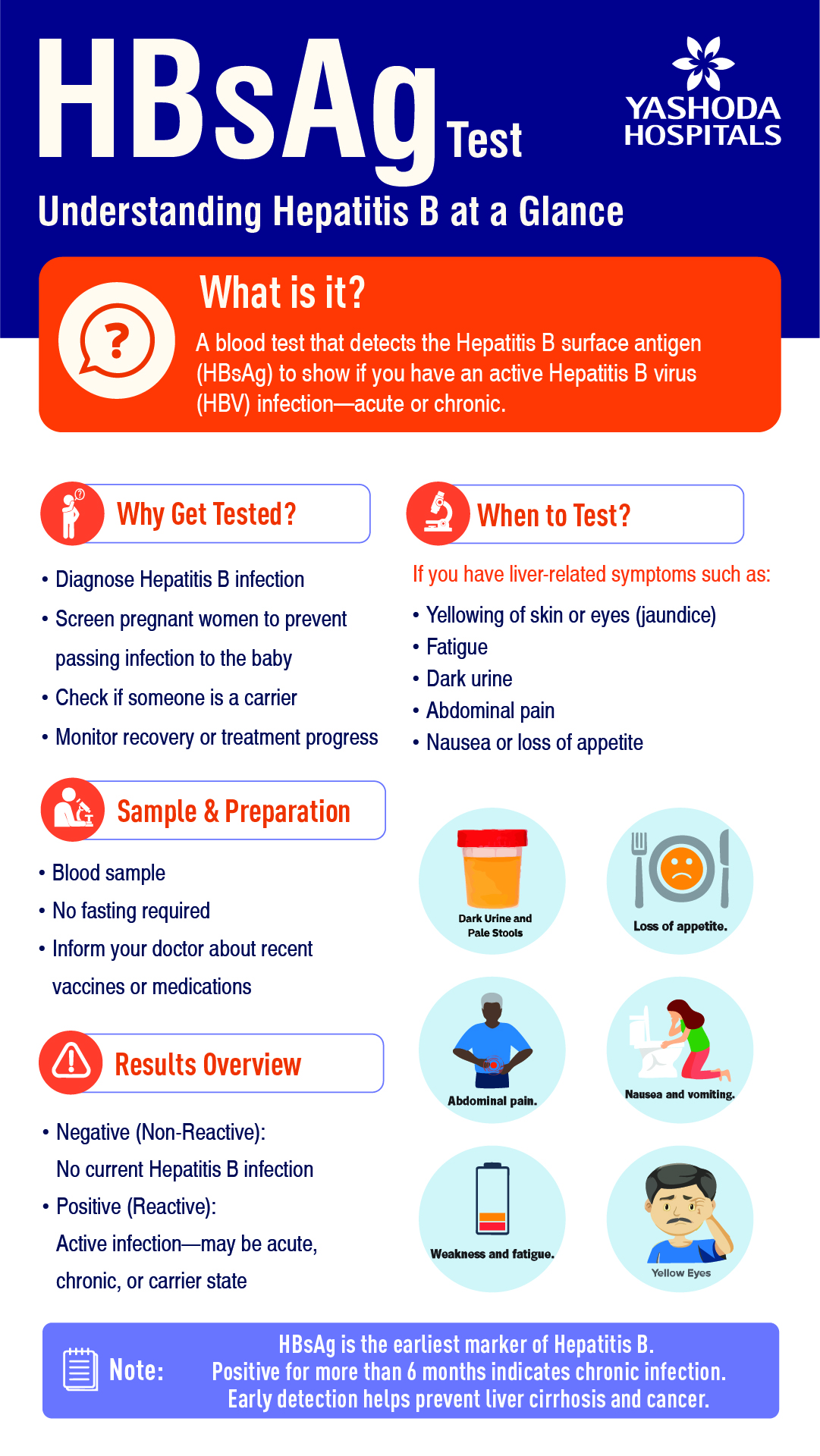
Uses Of HBsAg Test
- Identifies active infection with the Hepatitis B Virus.
- Assists in early diagnosis of infected individuals, even before symptoms appear.
- Utilized for screening blood donors to prevent Hepatitis B transmission.
- Helps in observing the course of Hepatitis B infection.
- Assists in examining the effectiveness of anti-viral therapy.
- Utilized in public health programs for controlling infection and surveillance.
- Supports diagnosis in patients with abnormal liver function tests.
- Assists in identifying the carriers of the Hepatitis B virus.
Indications Of HBsAg Test
- When signs of hepatitis appear (jaundice, tiredness, dark urine, and abdominal pain).
- If the individual has been exposed to infected blood or body fluids (needle stick injury, or unprotected sex).
- During pregnancy, to prevent the mother-to-child transmission.
Before blood donation or organ transplantation. - In patients with high-risk behaviours (IV drug use, multiple sexual partners).
- For healthcare workers and laboratory professionals at risk.
- In patients undergoing dialysis or immunosuppressive treatment.
- When liver enzymes like Alanine Transaminase (ALT), and Aspartate Aminotransferase (AST) are elevated.
- The HBsAg test is strongly recommended for family members and close contacts of infected patients.
- For pre-employment or pre-surgical screening in some organisations.
Preparation Before HBsAg Test
Preparation for the HBsAg evaluation is straightforward, as it is a routine blood test and typically does not require additional precautions. Nevertheless, a few basic steps help ensure precise outcomes and a smooth examination process.
- Before an HBsAg examination, fasting is not required; the examination can be performed at any time of day.
- Before undergoing an HBsAg evaluation, the patient should inform the physician of any current medications, supplements, or herbal products they are taking.
- The patient should disclose any recent vaccinations, particularly for Hepatitis B, as these may influence the interpretation of the results.
- The patient should inform the healthcare professional of any existing medical conditions, particularly liver or immune-related diseases.
- The patient should strictly avoid alcohol consumption for at least 24 hours before the HBsAg examination, as this might influence the liver-related parameters.
- The patient should stay well hydrated for the blood collection process.
- The patient should wear comfortable clothing with easy access to the arm for a blood draw.
- The patient should follow specific instructions given by the healthcare provider or laboratory.
Procedure Of HBsAg Test
- The patient who requires an HBsAg test is first identified, and basic details are recorded.
- The procedure is explained to the patient, and consent is obtained.
- The patient is asked to take a seat comfortably, normally with the arm extended.
- A tourniquet (strap) is tied around the upper arm to make the veins more visible.
- The skin over the vein (usually in the inner elbow area) is cleaned by using an antiseptic solution.
- A sterile needle is then thrust into the vein to collect the blood sample.
- Blood is drawn into a collection tube (Vacutainer).
- Once sufficient blood is collected, the needle is then gently removed.
- Pressure is applied to the puncture site with cotton or gauze to stop the bleeding.
- A Bandage may be placed over the site.
- Laboratory evaluation involves labeling the blood sample properly and then sending it to the laboratory.
- The sample is then processed, and serum or plasma is separated.
- The HBsAg test is performed using immunoassay methods such as ELISA or rapid tests.
- The presence of Hepatitis B surface antigen (HBsAg) is then detected.
- Outcomes are recorded as positive or negative based on antigen detection.
- Following HBsAg testing, the patient may resume normal activities as soon as possible.
- Outcomes are typically available to the patient within a few hours to a day, depending on the laboratory.
Benefits Of HBsAg Test
- Enables early diagnosis of Hepatitis B infection, even before the symptoms appear.
- Assists in the identification of asymptomatic individuals who can unknowingly act as asymptomatic carriers, thereby decreasing the silent transmission of the virus.
- Support on-time medical intervention and appropriate planning of the treatment.
- Helps doctors and other healthcare professionals monitor disease progression and infection status.
- Helps examine the effectiveness of ongoing antiviral treatment.
- Decreases the risk of transmission through early identification and preventive measures.
- The HBsAg test is vital for pre-transfusion screening and for organ donation screening.
- Helps prevent mother-to-child transmission of Hepatitis B during pregnancy.
- Useful in regular health screenings and preventive healthcare programs.
- ‘Helps in detecting high-risk individuals for further examination and follow-up.
- Contributes to public health control and surveillance of Hepatitis B infection,
- Provides dependable and precise diagnostic outcomes with minimal invasiveness.
- Assists in guiding vaccination and post-exposure prophylaxis decisions.
- Exhibits a vital role in reducing complications such as liver damage and long-term infection.
Factors Influencing HBsAg Diagnostic Test Results
- Stage of Hepatitis B infection.
- Window Period.
- Viral load.
- Recent Hepatitis B vaccination.
- Antiviral treatment.
- Immune status.
HBV mutant strains. - Coinfections such as HIV or other Hepatitis viruses.
- Testing method (ELISA, CLIA, or rapid tests).
- Sample quality (hemolysis or contamination).
- Timing of sample collection.
- Laboratory/ Technical errors.
- Cross reactivity.
- Chronic carrier state.
- Infection clearance phase.
- Sample storage and transport.
- Individual biologic variations.
Types Of HBsAg Test
Rapid HBsAg Test (Card/Strip method): Is a quick screening evaluation that provides outcomes within minutes, utilizing a small blood sample. It is primarily used in emergency settings and field screenings, but it may be less sensitive than laboratory techniques.
ELISA (Enzyme-Linked Immunosorbent Assay): A highly sensitive and widely utilized laboratory method for identifying HBsAg. It is suitable for large-scale screening and yields reliable, precise results.
CLIA (Chemiluminescent Immunoassay): A modern automated technique that utilizes light emission to identify HBsAg. It offers high sensitivity and specificity, and enables faster processing in modern laboratories.
ECLIA (Electrochemiluminescence Immunoassay): A refined version of CLIA that utilizes electrochemical reactions to enhance diagnostic precision. It is highly accurate and commonly utilized in modern diagnostic settings.
RIA (Radioimmunoassay): An older technique that utilizes radioactive substances to diagnose antigens. Although very sensitive, it is now less commonly utilized due to safety concerns and the availability of better alternatives.
CMIA (Chemiluminescent Microparticle Immunoassay): Utilizes microparticles combined with chemiluminescence to enhance antigen identification. It provides highly precise, automated results in clinical laboratories.
MEIA (Microparticle Enzyme ImmunoAssay): A variation of ELISA that utilizes microparticles to increase reaction efficiency. It increases sensitivity and is utilized in certain automated systems.
Neutralization/Confirmatory HBsAg Assay: This evaluation is utilized to confirm positive HBsAg outcomes by specifically neutralizing the antigen. It helps eliminate false-positive results and ensures diagnostic precision.
Quantitative HBsAg Evaluation: Quantifies the exact amount of HBsAg present in the blood rather than just detecting it. It is useful for monitoring disease progression and treatment response in Hepatitis B.
Interpretation Of HBsAg Results
Negative HBsAg Result:
Indicates no current Hepatitis B infection.
An individual either has no infection or is in the early “window period” (The time between potential exposure to infection, and when a laboratory evaluation can accurately identify it).
Might also indicate prior recovery, with viral clearance.
Positive HBsAg Result:
Indicates active Hepatitis B infection.
A person is infectious and can transmit the infection.
Requires further evaluations (eg, HBV DNA, HBeAg) for confirmation and staging.
Acute Infection:
If the patient is HBsAg positive for less than 6 months.
Usually associated with recent infection.
The infection might resolve spontaneously or progress.
Chronic Infection:
HBsAg remains positive for more than 6 months.
Indicates a long-term Hepatitis B infection.
Greater risk of liver complications.
Carrier State:
HBsAg positive without any symptoms.
Low activity of the virus, but it might still be infectious.
False Positive:
Might occur due to technical errors or cross-reactivity.
Requires confirmatory testing.
Important Notes:
Interpretation should always be done along with other markers (anti-HBs and anti-HBc).
Clinical Co-relation and medical consultation are vital.
Side Effects Of HBsAg Test:
HBsAg testing is a simple blood test and is usually very safe, with minimal to no serious adverse effects. Nevertheless, a few minor effects might occur at the site of blood collection.
- Mild pain or discomfort at the site of injection.
- Slight bleeding after the removal of the needle.
- Swelling or tenderness in the area.
- Dizziness or lightheadedness.
- Fainting (very rare).
- Risk of infection at the site of the puncture.
Overall, HBsAg testing is a low-risk procedure used to identify Hepatitis B, and any side effects are usually short-term and resolve quickly without the need for immediate medical intervention.







 Appointment
 Second Opinion
 Live Chat
 Call
Call More
More