


What is the CK-MB test?
The Creatine Kinase-MB (CK-MB) examination is a notable blood evaluation that provides vital information about the condition of your heart muscles. Creatine Kinase is an enzyme found in various parts of the body, including the heart, brain, and skeletal muscles. The CK-MB fraction is a specific type that is mainly associated with the heart muscle. Especially when the heart muscle is affected or stressed, this enzyme is released into the bloodstream, making it measurable through laboratory analysis. Clinically, the CK-MB evaluation is extensively utilized as a part of cardiac examination. It offers valuable insight into changes that occur within the heart, mainly when there is a concern about damage or decreased blood supply. The CK-MB evaluation is mostly considered alongside other laboratory tests and clinical findings to build a complete understanding of one’s heart health. With developments in diagnostic technology, the CK-MB evaluation has become more precise and accessible in both emergency situations and routine settings. The CK-MB Test is a straightforward and dependable test that assists doctors and healthcare professionals in observing patterns that are related to heart muscle activity. Overall, the CK-MB evaluation plays a vital role in cardiac care by offering quantifiable insights into how one’s heart functions and thereby supporting informed medical testing.
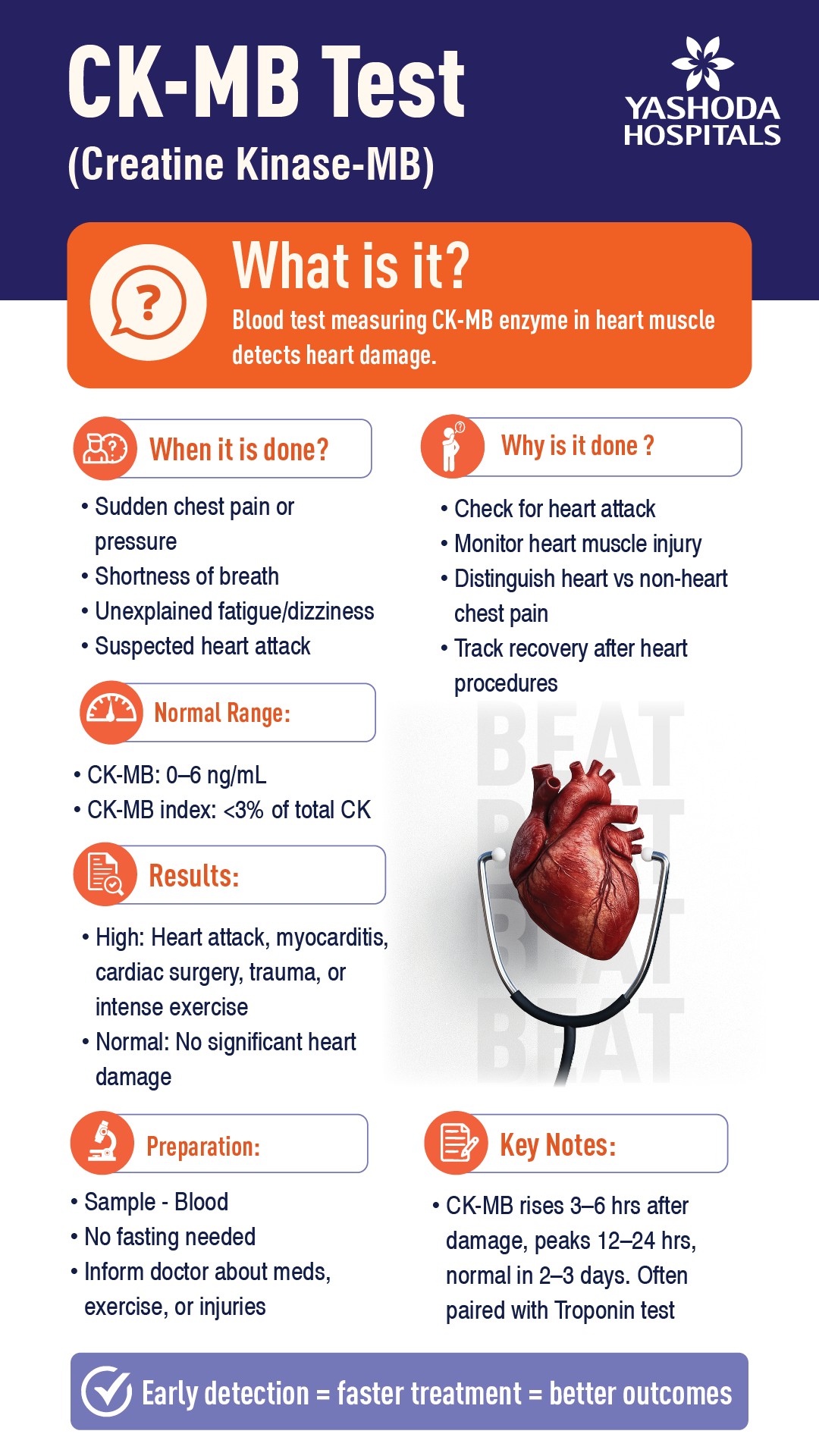
Uses of the Creatine Kinase-MB (CK-MB) Diagnostic Test
- The CK-MB tests assist in the diagnosis of damage to the heart muscle, and are used to identify heart attacks (myocardial infarction).
- The CK-MB test also helps the doctor or healthcare professional in observing heart conditions over a period of time.
- The test also helps in examining chest pain complaints by an individual that can be related to heart issues.
- The CK-MB test is quite useful in evaluating re-infarction that is a repeat heart attack. Additionally, the test supports doctors and healthcare professionals in cardiac risk evaluation.
- The CK-MB evaluation assists in monitoring how the patient’s body responds to treatment issued for cardiac problems.
Indications of the Creatine Kinase-MB Diagnostic (CK-MB) Test:
- The Creatine Kinase-MB (CK-MB) test is suggested when an individual has chest pain or discomfort.
- The test is recommended when the patient complains of shortness of breath, and there is a suspicion of a heart attack.
- The test is also advised when the pain affects the arm, neck, or jaw, or the individual or patient experiences sudden sweating and dizziness.
- The CK-MB test is also suggested in individuals who show abnormal electrocardiogram results or when there is a clinical suspicion of heart muscle injury.
Preparation Before Creatine Kinase-MB Diagnostic (CK-MB) Test:
- Before the patient undergoes a Creatine Kinase-MB test, they do not require any special fasting. They can eat and drink normally unless advised by a doctor or healthcare professional.
- The patient should inform the doctor about all the medicines they are taking, as some medicines might impact the CK-MB test results.
- The patients should also avoid any heavy exercise before the test, as this might also affect CK-MB test results.
- The patient, before undergoing a CK-MB analysis, should stay calm and relaxed prior to the sample collection.
Procedure For Creatine Kinase-MB Diagnostic (CK-MB) Test:
- The CK-MB test is a simple blood test, where a healthcare professional cleans the area on the patient’s arm.
- A sterile needle is then thrust into a vein to collect blood, and then a small amount of blood is drawn into the tube.
- Pressure is applied after removing the needle, after which the sample is sent to the laboratory for evaluation.
- The sample collection process for the CK-MB diagnostic test procedure takes only a few minutes.
Benefits of Creatine Kinase-MB Diagnostic (CK-MB) Test:
- The CK-MB test assists in early identification of damage to the heart muscle, along with providing valuable information about one’s heart health.
- The CK-MB test supports patients receiving timely medical care, as it is a fast and dependable diagnostic evaluation for heart issues.
- The CK-MB test assists in monitoring heart conditions and issues effectively; additionally, this also helps in improving patient care and overall results at the end of the treatment cycle.
Factors Influencing Test Results of Creatine Kinase-MB Diagnostic (CK-MB) Test:
- If the patient has done intense exercise recently/ or before undergoing the CK-MB diagnostic test, results might be affected by it.
- If the individual has any muscle injuries, it can increase the levels of CK-MB in the diagnostic evaluation.
- If the patient is taking certain medicines that might also influence the final results of the CK-MB diagnostic test.
- If the patient is suffering from kidney diseases, it can also affect Creatine Kinase enzyme levels, thereby influencing results.
- The timing of the CK-MB test is very important after the patient starts experiencing symptoms of heart disease.
- Improper sample handling, along with improper storage, might also affect the accuracy of the CK-MB diagnostic test.
Types Of Creatin Kinase (CK-MB) Diagnostic Test:
CK-MB Mass Assay:This test calculates the amount of CK-MB protein present in the blood accurately. It is very sensitive and mostly utilized in modern laboratories for accurate identification/diagnosis.
CK-MB Activity Assay:This test measures the activity of the CK-MB enzyme rather than its amount/quantity. It’s an old method and is less commonly utilized at present.
Interpretation Of Creatin Kinase (CK-MB) Diagnostic Test Results:
Normal CK-MB Level (< 5 ng/mL):This indicates no significant heart muscle damage.
Mild Elevation In CK-MB Level (5-10 ng/mL):This might indicate a minor heart stress or early changes.
Moderate CK-MB Level Elevation (10-25 ng/mL):This might indicate a possible heart muscle injury in the patient and requires evaluation.
High CK-MB Level Elevation (> 25 ng/mL):This is strongly associated with significant heart muscle damage, such as a heart attack.
Side Effects Of Creatin Kinase (CK-MB) Diagnostic Test:
Common (Mild) Side Effects:
- Pain or slight discomfort at the needle insertion site.
- Bruising (hematoma) at the site of the puncture.
- Mild Bleeding after the needle is removed.
- Dizziness or lightheadedness.
- Fainting (Vasovagal response) in sensitive individuals.
Rare Side Effects
- Infection at the site of puncture.
- Excessive bleeding, mainly in individuals with bleeding disorders.
- Swelling or Inflammation at the site.
- Multiple needle attempts if veins become difficult to locate.







 Appointment
 Second Opinion
 Live Chat
 Call
Call More
More