


ASO (Antistreptolysin O) Diagnostic Test
The Antistreptolysin O (ASO) evaluation is a blood examination utilized to identify antibodies produced by the body against streptolysin O, a toxin released by Streptococcus bacteria, especially Group A streptococcus. The ASO evaluation plays a vital role in identifying recent or past streptococcal infections, mainly when problems such as rheumatic fever or post-streptococcal glomerulonephritis are suspected. Since the bacteria might no longer be present inside the body at the time of evaluation, the ASO test assists by identifying the immune response rather than the organism itself. It is especially useful in patients who present with symptoms like joint pain, fever, sore throat, skin infection, and kidney disease. The ASO test is simple, minimally invasive, and provides important information that helps in the diagnosis, monitoring, and management of post-infectious problems.
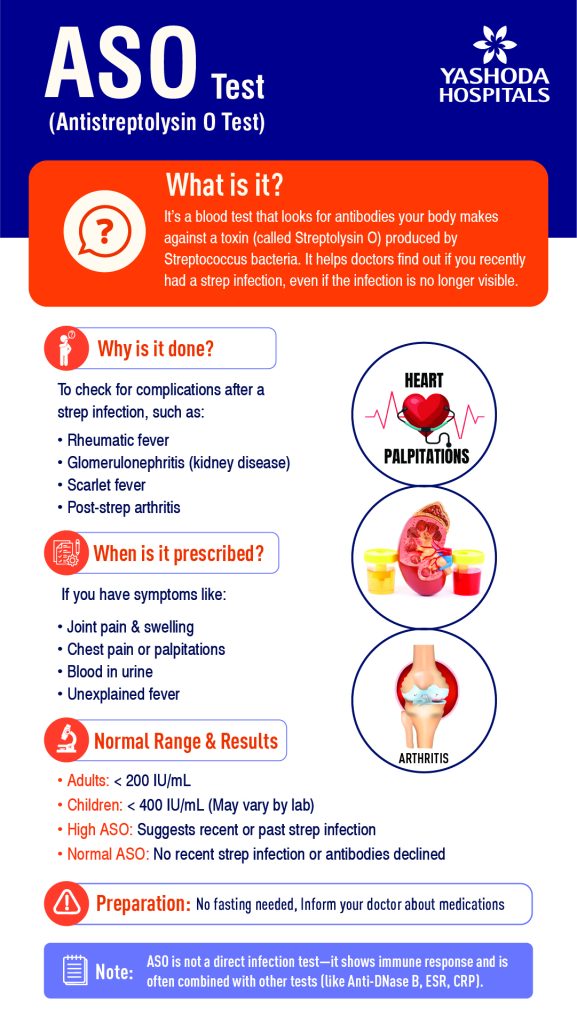
Uses of the Antistreptolysin O (ASO) Test:
- The ASO Test is utilized to identify the latest streptococcal infections.
- The test also assists in identifying problems such as rheumatic fever and post-streptococcal glomerulonephritis.
- It is also useful in examining unexplained joint pain or inflammation, and assists in monitoring response to treatment in some conditions.
Indications of the Antistreptolysin O (ASO) Test:
- The ASO test is indicated in patients with a history of recent sore throat or skin infection, along with being suggested when signs like joint pain, fever, or swelling are present.
- The ASO test is also performed when rheumatic fever is suspected, or in cases of kidney inflammation after infection.
- The ASO test is also used when there are signs of post-infectious complications.
Preparation For The Antistreptolysin O (ASO) Test:
- The patient requires no special fasting before the ASO test.
- The patient should inform the doctor about any medicines being taken or in case of recent infections.
- Also, the patients should follow all the additional instructions that are provided by the healthcare provider.
- The patient is suggested to be properly hydrated before undergoing the ASO Test.
Procedure Of The Antistreptolysin O (ASO) Test:
- The ASO test is done using a blood sample collected from a vein.
- Followed by this, the puncture site is cleaned with the help of an antiseptic solution.
- A sterile needle is then thrust to draw a small amount of blood.
- Then the collected blood sample is sent to the laboratory for antibody evaluation.
- The ASO test measures the level of ASO antibodies that are present in the blood.
- The outcomes of the ASO test are normally available within a few hours to a day.
Benefits Of The Antistreptolysin O (ASO) Test:
- The ASO tests assist in diagnosing recent streptococcal infections even after the symptoms have eased.
- It helps in the early identification of serious issues like rheumatic fever.
- The ASO test is straightforward, quick, and minimally invasive. It supports timely treatment and prevents problems.
- The ASO test is also useful in monitoring disease progression and recovery.
Factors Influencing Results Of Antistreptolysin O (ASO) Test:
- Early evaluation might result in false-negative outcomes if the antibodies have not yet developed.
- Antibiotic treatment might reduce the levels of antibody, whereas individual immune responses might vary and can affect ASO results.
- Repeated infections might also lead to continuously elevated levels of ASO. Along with laboratory variations and techniques that might also influence accuracy.
Types of Antistreptolysin O (ASO) Test:
The Quantitative ASO test measures the exact level of ASO antibodies in the blood and provides numerical values. It is useful for monitoring the progression of disease and response to treatment over time.
The Qualitative ASO test provides a simple positive or negative result, suggesting the presence or absence of ASO antibodies. This is commonly used in the initial screening.
The Latex Agglutination evaluation is a quick screening method in which latex particles coated with antigens react with ASO antibodies, thereby producing visible clumping if the outcome is positive.
Interpretation of Antistreptolysin O (ASO) Test Results:
- The normal reference range for ASO level is normally less than 200 IU/mL in adults, and less than 150-200 IU/mL in children, although values might differ slightly by laboratory.
- A normal or low ASO level suggests no recent streptococcal infection.
- Increased ASO levels (above 200 IU/mL) suggest a recent or past streptococcal infection.
- Rising ASO levels in repeated tests indicate an active or recent infection, while falling levels indicate recovery.
- The results of the test should always be interpreted in conjunction with clinical symptoms and other investigations for precise diagnosis.
Side Effects Of Antistreptolysin O (ASO) Test:
- The ASO test is usually very safe and involves minimal risk.
- The patient might feel some pain and discomfort at the site of needle insertion.
- Mild bruising or swelling might occur in the short term.
- Some individuals might experience dizziness or lightheadedness.
- It is very rare, and minimal risk of infection at the site of puncture.







 Appointment
 Second Opinion
 Live Chat
 Call
Call More
More