


Beta hCG Diagnostic Test
Beta human chorionic gonadotropin (beta-hCG) is an important hormone that plays a vital role in the initial stages of pregnancy. Beta-hCG is produced shortly after the fertilized egg attaches to the uterine lining. This hormone acts as one of the body’s first biological signals that pregnancy has occurred. Beta-hCG is commonly referred to as the “pregnancy hormone”; it is unique because it appears very early, even before many physical signs of pregnancy become noticeable. It is produced by specialized cells that later form part of the placenta, helping maintain the environment in which a new life can develop safely. As levels of the beta-hCG hormone increase, they reflect the body’s natural response to support a potential pregnancy. Apart from being related to pregnancy, beta-hCG helps doctors understand changes occurring in the body. Its levels give vital information about hormones and overall reproductive health.
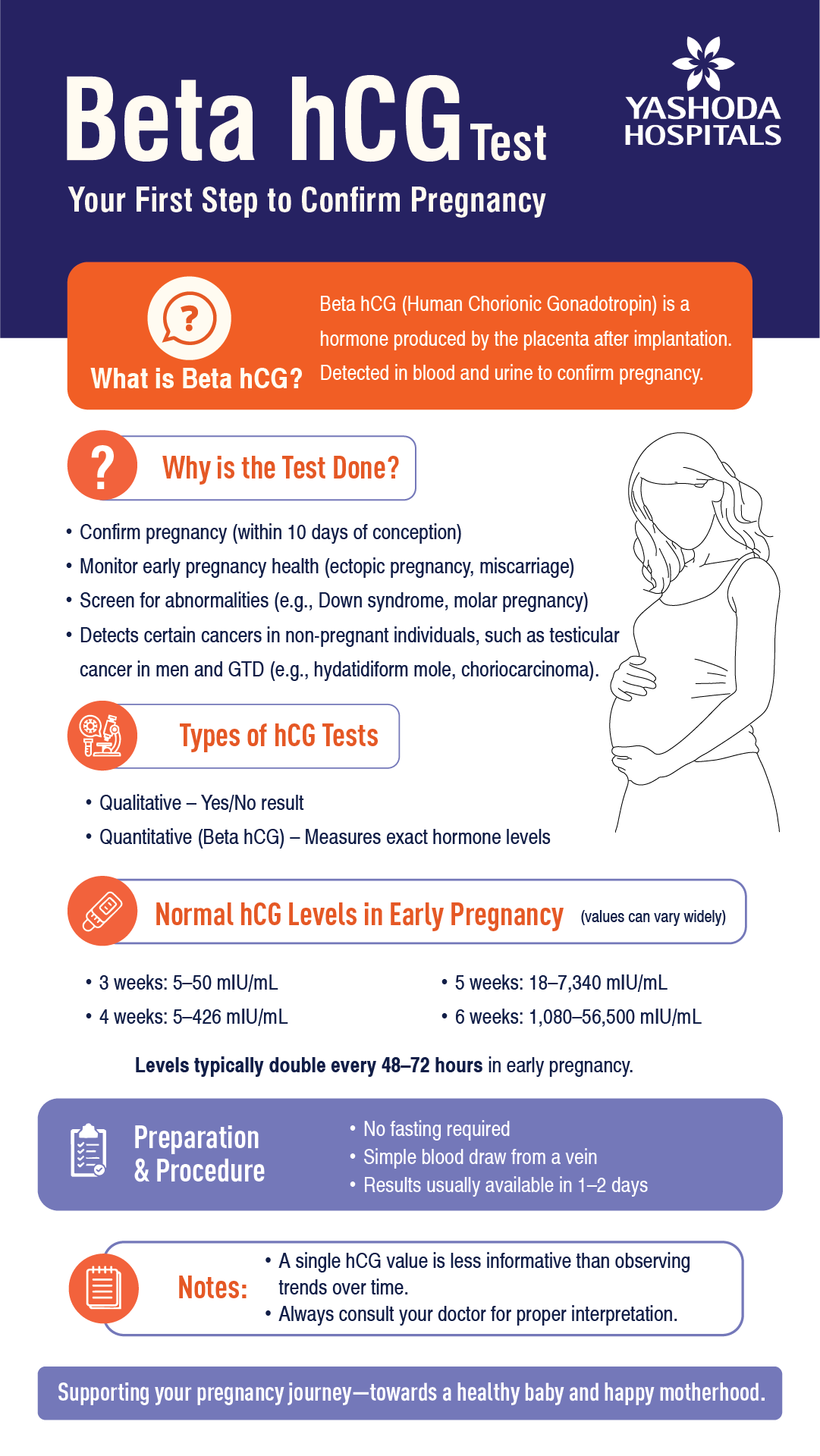
Uses of the Beta-hCG Test
- The Beta-hCG test is used to confirm early pregnancy and to monitor the growth and progress of pregnancy over time.
- Beta-hCG is also utilized to identify ectopic pregnancy, a medical emergency where the embryo (the initial stage of development of a baby) grows outside the main cavity of the uterus.
- Beta-hCG is also used to identify the risk of miscarriage or pregnancy issues, along with being utilized to monitor hormone levels after a miscarriage or abortion.
- Doctors use beta-hCG to examine unexplained vaginal bleeding and assist in evaluating infertility and ovulation-related issues.
- Beta-hCG is also utilized to identify gestational trophoblastic diseases, such as molar pregnancy, which is a rare pregnancy issue caused by unusual fertilization, where the placental tissue grows into a mass of cysts rather than a healthy fetus.
- Beta-hCG also acts as a tumor marker for some of the cancers, namely, testicular cancer. Along with being used in identifying ovarian germ cell tumors.
- It assists in tracking the success of cancer treatment in hCG-producing tumors, thus being included as part of prenatal screening with other markers.
Indications of the Beta-hCG Test
- Beta-hCG is suggested for an individual when pregnancy is presumed or needs confirmation.
- It is recommended by specialists in cases of unusual vaginal bleeding.
- It is also suggested that if there is pelvic pain, it suggests that there is an ectopic pregnancy, which is a medical emergency, where the embryo (the initial stage of development of a baby) grows outside the main cavity of the uterus.
- It is also recommended for women who have missed or have delayed menstrual periods, or if there is a history or risk of miscarriage.
- It is also suggested in cases where gestational trophoblastic disease is suspected or in some cancers where testicular or ovarian tumors are suspected.
- Beta-hCG is also used for examining infertility issues, and during and after fertility treatments.
- It is also suggested to monitor recovery after miscarriage, abortion, or pregnancy-related issues, along with suspected hormonal imbalance.
Preparation Before Beta-hCG Test
- No special preparation is required before a beta-hCG evaluation. Fasting is also not needed; a patient can eat and drink normally.
- The patient should inform their doctor about all the medicines that they are taking, and mention the use of fertility drugs or hormonal treatments.
- The patient should avoid self-medication before a beta-hCG test unless advised, and share relevant medical history (like recent pregnancy, miscarriage, or abortion).
- The patient should stay calm and hydrated before undergoing a beta-hCG test, and follow all the specific instructions that are given by the doctor.
Procedure of the Beta-hCG test
- The beta-hCG evaluation normally involves collecting a blood sample from a vein.
- A healthcare professional cleans the area (usually the arm) with an antiseptic, and a sterile needle is thrust through the vein to draw blood.
- A small amount of blood is then collected into the test tube, the needle is removed, and a cotton bandage is applied to stop bleeding.
- The collected blood sample is then sent to a laboratory for analysis, and the lab measures the level of beta-hCG hormone in the blood.
- The results of beta-hCG are usually available within a few hours to a day, depending on the lab.
Benefits of Beta-hCG Test:
- Helps in identifying pregnancy at a very early stage and provides precise and dependable outcomes.
- The beta-hCG helps the doctors in observing problems like ectopic pregnancy (a medical emergency where the embryo (the initial stage of development of a baby) grows outside the main cavity of the uterus, pretty early.
- The Beta-hCG evaluation helps in diagnosing the risk of miscarriage and is useful in detecting gestational trophoblastic disease.
- Beta-hCG also acts as a tumor marker to diagnose some cancers and monitor the success of those cancer treatments.
- The test helps examine infertility issues and helps in the observation of fertility treatments.
- It is also helpful in detecting pregnancy-related issues.
- The Beta-hCG test is fast and straightforward, which causes minimal discomfort, and needs no special preparation.
- It can be repeated multiple times to track changes over time, which helps doctors in making timely and informed medical decisions.
Factors Influencing Test Results of Beta-hCG:
- The stage of pregnancy, as levels of Beta-hCG change very quickly in early weeks.
- The presence of multiple pregnancy (twins or more) can depict higher beta-hCG levels.
- Ectopic pregnancy is a medical emergency where the embryo (the initial stage of development of a baby) grows outside the main cavity of the uterus, which might result in lower or slowly rising levels of beta-hCG.
Miscarriage, or a non-viable pregnancy, can also cause decreasing beta-hCG levels. - Some medicines, especially medicines that contain beta-hCG, can influence the results of the beta-hCG test.
- Some tumors, like testicular and ovarian tumors, produce beta-hCG, which can also impact the results of the beta-hCG.
- A recent pregnancy, miscarriage, or abortion also affects residual beta-hCG hormone levels.
- Variations in laboratory results ot differences in testing methods can also influence the results of the beta-hCG test.
- The timing of the beta-hCG test, as very early testing might also give low or unclear outcomes.
- Individual hormonal variations between different people also impact beta-hCG test results, along with improper sample handling or storage of the sample inside the lab.
- Patients dealing with rare medical conditions that affect the beta-hCG hormone production can also impact the test results of beta-hCG.
Types of Beta-hCG Test
Qualitative Beta-hCG Evaluation:Is a examination that simply checks whether the beta-hCG hormone is present or not inside the body. It gives a “Yes” or “No” outcome, making it vital for confirming pregnancy.
Quantitative Beta-hCG examination (Serum hCG test):Is a evaluation that quantifies the exact amount of beta-hCG hormone in the blood. It assists in understanding how hormone levels change over time and thus provides in-depth information.
Urine Beta-hCG test:This type diagnoses the presence of beta-hCG in urine. It is mostly utilized in home pregnancy test kits and provides quick outcomes.
Serial Beta-hCG Testing:In this method, the quantitative evaluation is repeated over a period of time. It assists in tracking how beta-hCG levels rise or fall, which is important in monitoring pregnancy or some medical conditions.
Interpretation of Beta-hCG Test Results:
Non-Pregnant (Negative Beta-hCG Result):An evaluation where Beta-hCG levels are usually less than 5 mIU/mL, which suggests that there is no pregnancy.
Indeterminate/ Borderline Range:An evaluation where Beta-hCG levels are between 5-25 mIU/mL, it is normally considered unclear. Repeated testing is normally advised after 48 hours.
Positive Pregnancy:Beta-hCG levels above 25 mIU/mL normally indicate pregnancy.
Beta-hCG levels in Early Pregnancy
| Weeks of Pregnancy | Value of beta-hCG (mIU/mL) |
|---|---|
| 3 weeks | 5 to 50 |
| 4 weeks | 5 to 426 |
| 5 weeks | 18 to 7,340 |
| 6 weeks | 1,080 to 56,500 |
| 7–8 weeks | 7,650 to 229,000 |
| 9–12 weeks | 25,700 to 288,000 |
| 13–16 weeks | 13,300 to 254,000 |
| 17–24 weeks | 4,060 to 165,400 |
| 25–40 weeks | 3,640 to 117,000 |
Rapidly Increasing Levels:A rise of about 2 times every 48-72 hours in early pregnancy suggests normal development.
Slow Increase or Plateau:Might indicate ectopic pregnancy or a non-viable pregnancy.
Falling Levels:Suggests miscarriage or pregnancy risks.
Very High Levels:Might indicate multiple pregnancy or a molar pregnancy.
Persistently Elevated (Non-Pregnant):Could suggest trophoblastic disease or beta-hCG-secreting tumors.
Side effects of Beta-hCG Test:
- Mild pain or discomfort at the needle insertion site.
- Slight bruising around the puncture area.
- Minor bleeding after the blood draw.
Feeling of dizziness or lightheadedness in some individuals. - Rare chance of infection at the site of injection.
- Swelling or tenderness at the site for a short time.
- Very rarely faint due to the procedure.







 Appointment
 Second Opinion
 Live Chat
 Call
Call More
More