


Typhoid Fever: Warning Signs, Tests, Treatment & Prevention Tips
u003cpu003eu003ca class=u0022et_pb_buttonu0022 href=u0022#sec1u0022u003e1. Introduction u003c/au003eu003c/pu003enu003cpu003eu003ca class=u0022et_pb_buttonu0022 href=u0022#sec2u0022u003e2. A Clot u003c/au003eu003c/pu003enu003cpu003eu003ca class=u0022et_pb_buttonu0022 href=u0022#sec3u0022u003e3. What is Ischemic Strokeu003c/au003eu003c/pu003enu003cpu003eu003ca class=u0022et_pb_buttonu0022 href=u0022#sec4u0022u003e4. Symptomsu003c/au003eu003c/pu003enu003cpu003eu003ca class=u0022et_pb_buttonu0022 href=u0022#sec5u0022u003e5. Daignosisu003c/au003eu003c/pu003enu003cpu003eu003ca class=u0022et_pb_buttonu0022 href=u0022#sec6u0022u003e6. Treatmentu003c/au003eu003c/pu003enu003cpu003eu003ca class=u0022et_pb_buttonu0022 href=u0022#sec7u0022u003e7. Recoveryu003c/au003eu003c/pu003enu003cpu003eu003ca class=u0022et_pb_buttonu0022 href=u0022#sec8u0022u003e8. Preventionu003c/au003eu003c/pu003enu003cpu003eu003ca class=u0022et_pb_buttonu0022 href=u0022#sec9u0022u003e9. Conclusion u003c/au003eu003c/pu003e
u003cpu003eIt may not feel substantial in the beginning. The words from your mouth might come out a little unclear. One of the hands might feel a little more fragile than normal, followed by a little loss of balance in the walk. Initially, it’s easy to turn a blind eye, assuming it’s just tiredness or stress. But slowly, the symptoms become tough to dismiss. When blood fails to reach the brain, every passing second becomes a critical fight against time.u003cbr /u003eu003cstrongu003eBecause it only does you good to take action a minute too early, rather than a second too late.u003c/strongu003e u003c/pu003e
Typhoid fever is a life-threatening illness caused by the bacterium called Salmonella Typhi. The bacteria slowly make their way to the bloodstream and the inner lining of the gut. It is transmitted through contaminated food and water, mostly affecting your intestines, liver, and spleen. It is also called enteric fever and produces symptoms such as a prolonged high fever, fatigue, severe headache, and gastrointestinal problems, including constipation or diarrhea. Common in regions with inadequate sanitation and limited access to clean drinking water, typhoid fever remains a significant public health concern in countries like India. Though it is curable with clinically advised antibiotics, a delay in diagnosis or self-medication can endanger one’s life with severe complications such as intestinal perforation or hemorrhage. Hence, it is advisable to seek timely medical intervention and maintain necessary immunization and safe hygiene practices.
Despite being treatable with appropriate antibiotics, delayed diagnosis or improper treatment can result in severe complications such as intestinal perforation, hemorrhage, and even death, making early detection, prompt medical intervention, and preventive measures like safe hygiene practices and vaccination essential.
What are the causes and symptoms of typhoid fever?
A highly contagious bacterium called Salmonella Typhi (S. Typhi) causes typhoid fever, which is primarily transmitted through contaminated food and water. The symptoms, which typically appear within a week or 2 after exposure, get worse if they are not diagnosed or treated on time.
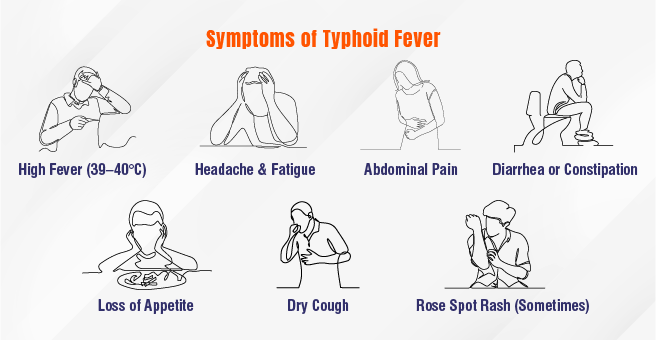
Key symptoms:
- Persistent high fever (often reaching 39-40°C)
- Prolonged headache and fatigue
- Abdominal pain or discomfort
- Diarrhea or, in some cases, constipation
- Loss of appetite
- Dry, persistent cough
- Skin rash with faint “rose spots” (seen in some patients)
Possible Complications (if not treated):
- Intestinal perforation (a hole in the intestine)
- Internal bleeding
- Severe infection spreading to other organs
Does Typhoid Fever Have Different Stages?
The symptoms eventually develop in four stages if the treatment is delayed in the initial stage. After being contacted by S. Typhi bacteria, you will have a high fever in the first 10 days (stage 1) when the bacteria slowly enter your bloodstream. At stage 2, the harmful bacteria invade and proliferate in the crucial parts of the immune system, which causes abdominal pain, diarrhea, or constipation, and skin rashes (looking like rose spots). Stage 3 is when the bacteria start causing life-threatening damage, such as internal bleeding and brain inflammation (encephalitis). In stage 4, the symptoms slowly subside, and the body starts the healing process. However, the bacteria sometimes reside in the gallbladder without causing visible symptoms, so you can still be contagious. Therefore, you should get tested again even if you feel better after the illness.
How is typhoid diagnosed?
The specialist diagnoses typhoid fever through clinical evaluation of your symptoms and multiple laboratory tests. You may also be asked about your travel history just to know the sources of exposure to typhoid. All the necessary information helps in personalizing the treatment method. The following are the common tests that are usually recommended for accuracy:
Blood Culture (Gold Standard): This is the most important and reliable test, which primarily detects the presence of bacteria (Salmonella Typhi) in your bloodstream and helps in guiding the subsequent treatment.
Widal Test: This blood test identifies the antibodies against Salmonella Typhi bacteria. Though it rarely gives specific results, this is usually done to evaluate the level of antibodies in response to specific antigens.
Typhi Dot Test (Rapid Test): This is considered a useful early screening tool as it provides more accurate and quicker results as compared to the Widal tests.
Stool Culture: A laboratory test that identifies the presence of bacteria in stool samples. It is more useful in the later stages of the disease to detect the chronic carrier who continues to release bacteria in the stool or urine for over a year after the initial exposure.
Urine Culture: A diagnostic test sometimes used to detect Salmonella typhi in urine, although it is generally less reliable compared to blood or stool cultures.
Bone Marrow Culture: A highly sensitive test capable of detecting infection even after antibiotic therapy has begun, typically reserved for complicated or unclear cases where other tests are inconclusive.
Blood culture remains the most accurate early diagnostic method. While rapid tests like Widal and Typhi Dot provide supportive information. All the results should be evaluated and interpreted by a doctor in conjunction with clinical symptoms.
Treatment and Management of Typhoid
Typhoid fever can only be treated with antibiotics. The choice of medication depends on multiple factors such as the severity of the illness, where the patient is located, and antibiotic resistance patterns. It is essential to complete the full prescribed course to prevent relapse and reduce the risk of antibiotic resistance. In some cases, bacterial strains may not respond to certain antibiotics, requiring doctors to adjust treatment accordingly. Paratyphoid fever is also managed using similar antibiotic therapies.
In severe cases or when complications arise, hospitalization may be necessary for close monitoring and supportive care. Patients may require intravenous antibiotics, fluids, and additional medications. In critical situations, doctors may also prescribe steroids to reduce inflammation and manage complications.
- Medications commonly used include:
- Azithromycin
- Ciprofloxacin
- Ofloxacin
- Levofloxacin
- Ceftriaxone
- Cefotaxime
- Cefixime
- Carbapenems
- Dexamethasone
Preventive Measures
Home remedies for typhoid are purely supportive and do not replace medical treatment. Simple practices like drinking boiled water can help prevent further infection, while fluids such as coconut water support hydration and electrolyte balance. Including buttermilk or yogurt may promote gut health, and mild herbal teas like ginger or tulsi can help ease digestion and discomfort.
During typhoid, following a light and easily digestible diet is essential to reduce strain on the digestive system. Soft foods such as rice, khichdi, porridge, boiled vegetables, bananas, and applesauce are generally well tolerated. At the same time, it is important to avoid foods that may irritate the gut or slow recovery, including spicy, oily, high-fiber, and processed foods.
Preventing typhoid largely depends on maintaining good hygiene and safe food and water practices. Consuming clean, freshly prepared meals and staying cautious about food sources can significantly reduce the risk of infection.
- Drink only clean, filtered, or boiled water to avoid contamination and reinfection
- Maintain proper hand hygiene, especially before eating and after using the restroom
- Prefer freshly cooked, home-prepared meals over outside or street food
- Include soft, low-fiber foods that are easy to digest and gentle on the stomach
- Avoid raw foods, heavy meals, sugary drinks, and carbonated beverages during illness
- Consider vaccination if you are at higher risk, such as frequent travelers to endemic areas
Typhoid fever is a potentially serious infection, but with timely diagnosis and appropriate treatment, most people recover completely. Early medical intervention, along with adequate hydration, balanced nutrition, and proper hygiene, significantly aids the healing process. While home remedies may help manage symptoms, they should never replace professional medical care. Seeking prompt attention and following the prescribed treatment plan are key to preventing complications and ensuring a safe recovery.
u003ch2u003e2) A Clot That Embezzles Your Time, Memory, and Lifeu003c/h2u003enu003cpu003eAll over the world, u003ca href=u0022https://www.yashodahospitals.com/blog/how-to-treat-acute-ischemic-stroke/u0022u003eischemic strokeu003c/au003e u003cstrongu003eis one of the prime causes of deathu003c/strongu003e and permanent disability. Many individuals get through a stroke but struggle with speech issues, weakness, memory problems, and even walking properly.u003c/pu003enu003cpu003eu003cstrongu003eThe probability of stroke increases with age,u003c/strongu003e especially after 55 years. Nevertheless, younger individuals can also suffer an ischemic stroke. The probability of ischemic stroke increases if the individual has someone in their immediate family who has suffered a stroke or pre-existing health issues, like u003ca href=u0022https://www.yashodahospitals.com/blog/hypertensive-heart-disease-or-high-blood-pressure/u0022u003ehigh blood pressure,u003c/au003e u003ca href=u0022https://www.yashodahospitals.com/diseases-treatments/diabetes-symptoms-treatment/u0022u003ediabetesu003c/au003e, high cholesterol, u003ca href=u0022https://www.yashodahospitals.com/blog/5-types-heart-diseases-causes-symptoms-risk-factors/u0022u003eheart issuesu003c/au003e, u003ca href=u0022https://www.yashodahospitals.com/blog/comprehensive-approach-for-obesity/u0022u003eobesityu003c/au003e, bad lifestyle habits like smoking, and lack of exercise.u003c/pu003enu003cpu003eAs recovery from ischemic stroke is usually longer, u003cstrongu003eischemic stroke not only affects the patient but also their familyu003c/strongu003e, as daily activities like bathing, dressing, or even eating become tough to execute. This gives enough impetus to take steps to prevent stroke by identifying early signs of danger.u003c/pu003e
u003ch2u003e3) When The Brain Goes Dark: Inside An Ischemic Strokeu003c/h2u003enu003cpu003eThe human brain hinges on a stable supply of oxygen. When blood that carries oxygen is obstructed, cells inside the brain cannot survive for long. u003cstrongu003eThe area with complete blockage is the most affected.u003c/strongu003e However, the surrounding area might still receive a small amount of blood. This area can be saved from damage if treatment is given in time, followed by recovery of the cells. u003cstrongu003eBut if the treatment is delayed, then the damage spreads.u003c/strongu003eu003c/pu003enu003cpu003eThis is why u003cstrongu003eu003ca href=u0022https://www.yashodahospitals.com/specialities/neurology/doctors/u0022u003eneurologistsu003c/au003e, neurosurgeons, and u003ca href=u0022https://www.yashodahospitals.com/specialities/interventional-radiology/doctors/u0022u003einterventional radiologistsu003c/au003eu003c/strongu003eu003ca href=u0022https://www.yashodahospitals.com/specialities/interventional-radiology/doctors/u0022u003e,u003c/au003e the team that is tasked with treating this obstruction called ischemic stroke, always emphasize that u003cstrongu003etime is of the essence.u003c/strongu003e Because even a few minutes can make a difference.u003c/pu003e
u003ch2u003e4) Signs of Ischemic Stroke That One Cannot Afford to Missu003c/h2u003enu003cpu003eThe signs of ischemic stroke mostly u003cstrongu003edevelop quickly, but occasionally they might begin gradually and become worse over time.u003c/strongu003eu003c/pu003enu003cpu003eu003cstrongu003eCommon symptoms includeu003c/strongu003e weakness or numbness on one side of the body, drooping of one side of the face, difficulty speaking or understanding what others speak, blurred or lost vision, trouble walking or dizziness, loss of balance, and sudden confusion.u003c/pu003enu003cpu003eu003cstrongu003eA simple yet effective method to retain the warning symptomsu003c/strongu003e of ischemic stroke is u003cstrongu003eFASTu003c/strongu003e. where “F” stands for face drooping, “A” stands for arm weakness, “S” stands for speech difficulty, and “T” stands for time to look for emergency help.u003c/pu003enu003cpu003eIf you observe the above symptoms in yourself or someone else, do not wait. Immediate medical attention can prevent serious consequences.u003c/pu003enu003cpu003eu003cimg src=u0022https://www.yashodahospitals.com/wp-content/uploads/2026/03/Ischemic-Stroke-2.pngu0022 width=u0022655u0022 height=u0022340u0022 alt=u0022ischemic-stroke-2u0022 class=u0022wp-image-641118 size-mediumu0022 /u003eu003c/pu003enu003cpu003e u003c/pu003e
u003cp style=u0022text-align: center;u0022u003eAct Fast – Every Second Counts In Stroke Careu003cbr /u003eu003ca href=u0022https://www.yashodahospitals.com/specialities/neurology/doctors/u0022u003eConsult A Neurologist Nowu003c/au003eu003c/pu003e
u003ch2u003e5) Clarity In The Chaos: How Ischemic Stroke Is Identifiedu003c/h2u003enu003cpu003eWhen an individual arrives at the hospital with a complaint of experiencing ischemic stroke symptoms, the doctors work quickly, as it’s a u003cstrongu003etime-critical medical emergency.u003c/strongu003e The process follows a u003cstrongu003emulti-step clinical and radiological pathway to differentiate it from hemorrhagic strokeu003c/strongu003e and other conditions that mimic stroke, namely u003cstrongu003ehypoglycemia or u003ca href=u0022https://www.yashodahospitals.com/diseases-treatments/epilepsy-seizures-convulsions-symptoms-types-seizures-treatment/u0022u003eseizuresu003c/au003eu003ca href=u0022https://www.yashodahospitals.com/diseases-treatments/epilepsy-seizures-convulsions-symptoms-types-seizures-treatment/u0022u003e.u003c/au003eu003c/strongu003eu003c/pu003enu003cpu003eu003cstrongu003eInitial clinical examinationu003c/strongu003e occurs in the field or emergency room and focuses on rapid recognition of ischemic stroke symptoms. The first evaluation is the u003cstrongu003eBE FAST assessmentu003c/strongu003e, where clinicians and first responders use this acronym to check for Balance loss, Eye/Vision changes, Facial drooping, Arm weakness, Speech difficulty, and the Time of symptom onset. This is followed by u003cstrongu003ephysical and neurological evaluationu003c/strongu003e, where doctors evaluate motor function, sensory perception, and coordination.u003c/pu003enu003cpu003eDoctors await listening to a carotid bruit (that is, a whooshing sound in the neck) with a stethoscope, which can indicate u003cstrongu003eatherosclerosis, a common cause of ischemic stroke. The NIH stroke scale (NIHSS)u003c/strongu003e is a standard 11-category evaluation used to quantify the severity of stroke and track changes over time.u003c/pu003enu003cpu003eu003cstrongu003eEssential brain imaging evaluationsu003c/strongu003e are the only way to confirm whether a stroke is ischemic or hemorrhagic, which is very important because the treatments for these two different types of strokes are very different.u003c/pu003enu003cpu003eu003cstrongu003eA non-contrast computed tomographyu003c/strongu003e scan is mainly the initial evaluation that is performed, because its primary goal is to stop blood loss. u003ca href=u0022https://www.yashodahospitals.com/diagnostics/mri-scan/u0022u003eu003cstrongu003eMagnetic resonance imagingu003c/strongu003eu003c/au003e with diffusion-weighted imaging is the most sensitive tool for diagnosing early ischemia, as it identifies brain tissue damage within minutes of onset. Vascular imaging techniques like u003ca href=u0022https://www.yashodahospitals.com/surgery-care/coronary-ct-angiography-ccta/u0022u003ecomputed tomography angiographyu003c/au003e and magnetic resonance angiography are used to determine the exact location of blood vessel blockage.u003c/pu003enu003cpu003eu003cstrongu003eLaboratory and diagnostic evaluationsu003c/strongu003e are done to detect the cause of stroke and rule out the conditions that mimic ischemic stroke symptoms. These involve u003cstrongu003eblood glucose evaluationu003c/strongu003e to check for hypoglycemia, which mimics stroke and must be ruled out immediately, followed by u003cstrongu003eblood panel evaluationu003c/strongu003e that includes a complete blood count to check for infection and coagulation tests to evaluate blood clotting ability. Along with this, u003cstrongu003ean electrocardiogram and an echocardiogramu003c/strongu003e are evaluations done to check for atrial fibrillation, which is a major source of blood clots that form elsewhere but travel to the brain.u003c/pu003enu003cpu003eu003cstrongu003eAdvanced and emerging methodsu003c/strongu003e for diagnosing ischemic stroke include u003cstrongu003ecomputed tomography/magnetic resonance perfusionu003c/strongu003e, a technique that measures the flow of blood to differentiate between the u003cstrongu003einfarct coreu003c/strongu003e (dead tissue) and the u003cstrongu003epenumbrau003c/strongu003e (salvageable tissue), which helps in extending the ischemic stroke treatment window by 24 hours in some cases. Carotid ultrasound is another technique that utilizes sound waves to check for narrowing or fatty deposits in the carotid arteries of the neck.u003c/pu003e
u003ch2u003e6) Saving A Life From Stroke: Where Urgency Meets Survivalu003c/h2u003enu003cpu003eAs ischemic stroke is defined as a time-critical medical emergency, treatment of it is similarly a u003cstrongu003erace against timeu003c/strongu003e, emphasizing reinstating blood flow to the brain as quickly as possible to limit permanent damage. u003cstrongu003eThe standard approachu003c/strongu003e for treatment is divided into emergency revascularization, hospitalization, and long-term rehabilitation.u003c/pu003enu003cpu003eu003cstrongu003eThe first approach is emergency revascularizationu003c/strongu003e, where the primary goal is to dissolve or physically remove the clot that blocks the artery that supplies blood to the brain. This is achieved by using thrombolytics, which are clot-busting medications. u003cstrongu003eAlteplaseu003c/strongu003e (tPA) is a gold standard medicine for ischemic stroke that is typically administered through the intravenous route within 3 to 4.5 hours of symptom onset. u003cstrongu003eTenecteplaseu003c/strongu003e (TNK) is an alternative to alteplase that can be quickly administered as a faster single bolus.u003c/pu003enu003cpu003eu003ca href=u0022https://www.yashodahospitals.com/surgery-care/thrombectomy/u0022u003eu003cstrongu003eMechanical Thrombectomyu003c/strongu003eu003c/au003e is a minimally invasive technique where the surgeon utilizes a catheter and stent retriever to physically remove large clots. This is effective up to 6-24 hours after symptoms begin in selective patients.u003c/pu003enu003cpu003eu003cstrongu003eAcute hospital managementu003c/strongu003e for treating ischemic stroke patients involves preventing further brain damage and managing any issues. This phase of treatment begins once the patient is stabilized. The first part is u003cstrongu003egeneral supportu003c/strongu003e to patients by providing a stable airway, breathing, and circulation, followed by u003cstrongu003eblood pressure controlu003c/strongu003e, where permissive hypertension is mostly maintained for the first 24-48 hours to ensure proper brain perfusion.u003c/pu003enu003cpu003eu003cstrongu003eGlucose levelsu003c/strongu003e are managed by keeping blood sugar between u003cstrongu003e140-180 mg/dLu003c/strongu003e and aggressively treating fevers to prevent metabolic stress on already damaged brain cells. u003cstrongu003eEdemau003c/strongu003e is controlled by drugs like u003cstrongu003emannitol or surgical decompressive hemicraniectomyu003c/strongu003e to relieve pressure.u003c/pu003e
u003cp style=u0022text-align: center;u0022u003eTime Lost Is Brain Lost – Get Stroke Care Nowu003cbr /u003eu003ca href=u0022#sidebaru0022u003eConsult A Specialist Immediatelyu003c/au003eu003c/pu003e
u003ch2u003e7) Recovery And Rehabilitation: Reclaiming Life Back From Ischemic Strokeu003c/h2u003enu003cpu003eu003cstrongu003eRecoveryu003c/strongu003e from ischemic stroke u003cstrongu003ediffers from one individual to anotheru003c/strongu003e. Some individuals recover quickly with little lasting damage, while others might face long-term issues.u003c/pu003enu003cpu003eu003ca href=u0022https://www.yashodahospitals.com/specialities/physiotherapy/u0022u003eu003cstrongu003eRehabilitationu003c/strongu003eu003c/au003e starts as soon as the individual becomes stable and includes physical therapy to improve strength and movement, speech therapy to improve communication, and occupational therapy to relearn daily tasks.u003c/pu003enu003cpu003eIf the brain has some ability to adapt and relearn the skills, the process then takes time and effort. u003cstrongu003eEmotional changesu003c/strongu003e are usual in ischemic strokes, as some individuals might feel sadness, frustration, or anxiety. u003cstrongu003eSupportu003c/strongu003e from family, friends, and healthcare providers u003cstrongu003ebecomes vital for recovery.u003c/strongu003e The earlier the treatment is provided, the better the chances of improvement.u003c/pu003e
u003ch2u003e8) Guarding The Brain From Another Ischemic Stroke Attacku003c/h2u003enu003cpu003eAfter an individual suffers from one ischemic stroke, the u003cstrongu003erisk of having another stroke is higher.u003c/strongu003e So prevention then becomes a major focus.u003c/pu003enu003cpu003eu003cstrongu003eSpecialists usually suggestu003c/strongu003e keeping blood pressure under control, managing diabetes properly, lowering blood cholesterol, taking prescribed medicines regularly, avoiding smoking, eating a healthy diet, exercising regularly, and maintaining a healthy weight.u003c/pu003enu003cpu003eSome individuals may need u003cstrongu003emedicinesu003c/strongu003e that prevent clots from forming again. If heart rhythm problems persist, special treatments are then necessary. u003cstrongu003eRegular u003ca href=u0022https://www.yashodahospitals.com/packages/u0022u003emedical checkupsu003c/au003eu003c/strongu003e are vital to monitor health conditions and decrease stroke recurrence in the future.u003c/pu003e
u003ch2u003e9) Ischemic Stroke: The Choice Between Minutes And Memoriesu003c/h2u003enu003cpu003eIschemic stroke does not just affect the brain; it impacts a life, a family, and their future. It has the capacity to change simple daily moments into challenges and turn ordinary days into turning points. But there is always hope. When warning signs are identified early and treatment is given quickly, it saves lives and abilities. Though the recovery might take time, and the journey may be tough, strength grows with support, care, and determination. Understanding the seriousness of ischemic stroke, acting without delay, and choosing healthier habits does make a lot of difference. Because when it comes to the matter of protecting brain health, every minute means protecting every memory and moment that matters.u003c/pu003enu003cp style=u0022text-align: center;u0022u003eu003cstrongu003eu003cemu003eSaving Minutes Means Saving Moments That Matter The Most u003c/emu003eu003c/strongu003eu003c/pu003e







 Appointment
 Second Opinion
 Live Chat
 Call
Call More
More