


For Years, She Thought It Was Pain Due To Periods. But It Was Endometriosis
Introduction
Living with endometriosis can feel like fighting an invisible battle every day. Many women experience severe pain, tiredness, and emotional stress for years before getting the right diagnosis. Endometriosis is a long-term condition in which tissue similar to the lining of the uterus grows outside the uterus, often affecting the ovaries, fallopian tubes, bladder, bowel, and other nearby organs. These growths can cause inflammation, scarring, and significant pain, making daily life challenging. However, with timely diagnosis, proper treatment, and support from family and healthcare professionals, women with endometriosis can manage their symptoms and lead healthier, more comfortable lives.
Endometriosis is a condition that mainly affects women during their reproductive years, from puberty to menopause. Although it usually improves after menopause, it can continue in about 2% to 5% of women. Symptoms often begin during the teenage years and may continue into adulthood. Women with a family history of endometriosis, those who have difficulty getting pregnant, or those who experience severe period pain, heavy menstrual bleeding, or ongoing pelvic pain are at a higher risk. Endometriosis affects about 1 in 10 women worldwide and can have a major impact on daily activities, relationships, emotional well-being, and overall quality of life.
Multiple Facets Of Endometriosis: Its Types And Stages
Endometriosis is classified into three main subtypes, depending on the location and extent of the lesions.
Superficial Peritoneal Endometriosis:
This is the most common type of endometriosis. Small patches of endometrial-like tissue grow on the peritoneum, the thin lining inside the pelvis that covers the pelvic organs. Although these patches are usually small and shallow, they can still cause pain and inflammation.
Ovarian Endometrioma:
This endometrioma, also termed a “chocolate cyst,” is a cyst that is filled with old dark blood that forms within the ovaries. It can damage healthy ovarian tissue, cause pelvic pain, and affect fertility.
Deep Infiltrating Endometriosis:
Deep Infiltrating Endometriosis is the most severe form of endometriosis, where the endometriosis tissue grows deeper than 5 mm below the tissue surface and can affect nearby organs such as the bowel, bladder, ureters, ligaments, and other organs in the pelvic region. It is mostly linked to causing serious pain and organ dysfunction.
Rare-Extra Pelvic Endometriosis:
This commonly affects organs in the pelvic region, such as the ovaries, uterus, and surrounding tissues. In rare cases, it can develop outside the pelvis, which includes the lungs and diaphragm, abdominal wall, urinary tract, intestines and appendix, pelvic nerves, and, even more rarely, the brain or other faraway organs.
The American Society for Reproductive Medicine (ASRM) classifies endometriosis into four stages based on the number, size, and location of lesions, and the presence of adhesions.
| Stage Of Endometriosis | Description |
| Stage 1 (Minimal) | Few superficial lesions with little or no scar tissue |
| Stage 2 (Mild) | More lesions that are deeper than stage 1 |
| Stage 3 (Moderate) | Many deep lesions, ovarian endometriomas, and some adhesions |
| Stage 4 (Severe) | Widespread deep lesions, large endometriomas, and dense adhesions that affect pelvic organs |
Identifying Endometriosis Early
The signs of endometriosis can differ to a great extent, but many signs are commonly stated. The most characteristic signs of endometriosis include
- Painful periods
- Persistent pelvic pain
- Pain during or after sexual activity
- Pain during bowel movements or urination
- Increased tiredness
- Difficulty conceiving.
- Some patients might also experience heavy menstrual bleeding or spotting in between periods.
Not all signs of endometriosis are visible or easily identifiable. Numerous patients feel regular tiredness, bloating, nausea, brain fog, disturbances in the sleep cycle, lower back pain, and emotional distress. These signs can greatly affect day-to-day activities, work performance, relationships, and overall quality of life. These occur even when outward symptoms of illness are not present.
The symptoms of endometriosis mostly occur in a cyclical sequence and are linked to changes in hormonal balance throughout this sequence of the menstrual cycle. Pain and inflammation might increase before and during menstruation, even though some patients might feel symptoms throughout the month. Monitoring the timing of signs can assist in detecting the pattern that might indicate endometriosis and support quick diagnosis.
The symptoms of endometriosis might be different in teenagers in comparison to adults. Serious menstrual cramps that do not get better with normal pain relief; period pain that might make you miss days at school or college; digestive issues, and pelvic discomfort are signs that should not just be dismissed as a normal part of growing up. Early identification can help avoid years of delayed diagnosis of endometriosis and its neglected, untreated symptoms.
The patient should talk to a healthcare professional if they:
- Feel serious pain during menstruation that disrupts their normal life.
- Feel persistent pelvic pain lasting beyond normal periods.
- Feel pain during intercourse, bowel movements, or urination.
- Experience unusual infertility or difficulty in getting pregnant.
- Missing work, school, or social gatherings because of symptoms.
- Observe symptoms that become worse gradually or do not respond to regular treatment.
Endometriosis can overlap with several other gynecological conditions, making diagnosis difficult. Symptoms can be identical to those of irritable bowel syndrome, adenomyosis, pelvic inflammatory disease, ovarian cysts, and interstitial cystitis. Because of this mimicry, in-depth medical testing is vital to ascertain the exact cause and lead to proper therapy.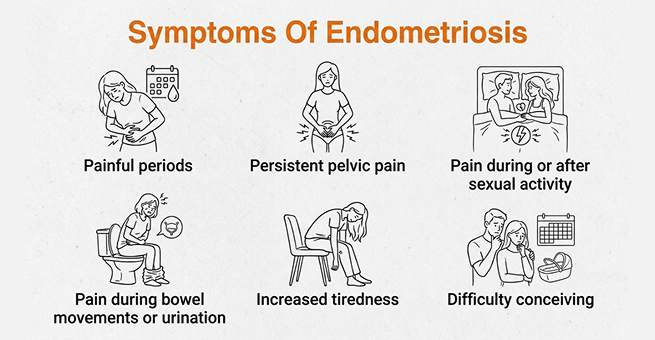
The Diagnostic Journey Of Endometriosis
Identifying endometriosis mostly needs a combination of clinical evaluation, imaging, and, in some patients, surgery.
Medical History and Symptom Evaluation:
The process of identifying endometriosis normally starts with an in-depth discussion of symptoms, menstrual history, pain patterns, concerns over fertility, and family history. This helps in diagnosing symptoms that might indicate the presence of endometriosis.
Pelvic Evaluation:
Your gynecologists might carry out a pelvic evaluation to check for tenderness, nodules, cysts, or abnormalities around the uterus, ovaries, and adjacent tissues. Nevertheless, many individuals with endometriosis mostly have a normal pelvic evaluation.
Symptom Diary:
Keeping a record of pain, bleeding patterns, signs of digestive issues, urinary symptoms, tiredness, and their timing during the menstrual cycle can help in supporting the identification and planning of treatment.
Transvaginal Ultrasound:
This is mostly the first imaging evaluation utilized. It can identify ovarian endometriomas and some cases of deep, penetrating endometriosis, but might miss superficial lesions.
Pelvic Ultrasound:
For women who cannot undergo a transvaginal scan, a pelvic ultrasound might be done to evaluate the reproductive organs.
Magnetic Resonance Imaging (MRI):
MRI gives in-depth pictures of pelvic structures and can assist in diagnosing deep infiltrating endometriosis, involvement of organs, and any complications in conditions before surgery.
Specialized Endometriosis Ultrasound Mapping:
It is done by highly skilled professionals and can examine the extent of how deep endometriosis is and its involvement in adjacent organs.
Blood Evaluations:
There is currently no blood evaluation that can certainly identify endometriosis. Blood evaluations are mostly utilized to rule out other conditions or evaluate endometriosis-related issues like anemia.
Diagnostic Laparoscopy:
Laparoscopy is a minimally invasive surgical procedure that allows direct views of endometriosis lesions inside the pelvis. Tissue samples might also be collected for confirmation. It remains the most definitive diagnostic method when needed.
Histopathological Evaluation (Biopsy):
During laparoscopy, if tissue is removed, it may be evaluated under a microscope to confirm the presence of endometriosis and rule out any other conditions.
During the initial appointments for endometriosis/appointment during the endometriosis diagnosis process, the patient should consider asking the following questions, like
- Are the symptoms that are being felt due to endometriosis?
- What diagnostic evaluations or imaging assessments do I require?
- If the outcome of imaging tests is normal, then what are the next steps?
- Do I require a laparoscopy to confirm the diagnosis?
- How does endometriosis affect fertility?
- What are treatment options available for symptoms?
- How can one manage pain and improve the quality of life?
The Sooner You Know, The Quicker You Heal
Take The First Step Towards Relief
Causes And Risk Factors
It is vital to remember that endometriosis develops via a complex mixture of biological, genetic, hormonal, immune, and environmental factors. No single theory can fully explain a single case.
Retrograde Menstruation Theory:
It is one of the most widely known theories. It proposes that during menstruation, some menstrual blood flows backward through the fallopian tubes into the pelvic cavity instead of leaving the body. Endometrial-like cells in the blood might attach to adjacent tissues, grow, and form endometrial lesions. Nevertheless, because most women experience retrograde menstruation without developing endometriosis, this theory does not explain all cases.
Coelomic Metaplasia Theory:
According to this theory, some cells that line the cavity of the pelvis can transform into endometrial-like cells under specific hormonal, inflammatory, or genetic influences. This might explain cases of endometriosis in other locations and in individuals who have attained menopause.
Stem Cell Theory:
Experts believe that stem cells from bone marrow or endometrium might travel through the bloodstream or the lymphatic system and develop into endometrial-like tissue outside the uterus. This theory assists in explaining how endometriosis occurs in parts of the body that are far away from the pelvic region.
Immune and Genetic Factors:
Genetics and a faulty immune system play a vital role in the cause of endometriosis. Individuals with a family history are at higher risk. In some cases, the immune system might fail to detect and remove endometrial-like cells, thereby allowing them to grow and survive.
Environmental and Lifestyle Factors:
Even though no single lifestyle factor can cause endometriosis, some factors might increase the risk or influence the spread of the disease. These include early menarche, short menstrual cycles, heavy menstrual bleeding, delayed childbearing, low body mass index, and a family history of endometriosis.
The Dangerous Myths That Delay The Answers: Endometriosis Facts You Need To Know
| Myths About Endometriosis | Facts About Endometriosis |
| A patient cannot have endometriosis if their periods are regular | Regular menstrual cycles do not rule out endometriosis. Most patients with the condition have highly predictable periods |
| Endometriosis only affects the reproductive organs | The disease can affect the bowel, bladder, diaphragm, nerves, and, in rare situations, other organs outside the pelvic region |
| Teenagers are too young to have endometriosis | Symptoms of endometriosis mostly start during adolescence, and some patients might experience symptoms soon after their first period |
| Endometriosis is caused by stress | Stress does not cause endometriosis, although long-term symptoms can increase emotional and psychological stress |
| If pain medicines work, then it is not endometriosis | Short-term symptom relief does not rule out the condition or decrease the long-term impact |
| You must have heavy periods to have endometriosis | Some individuals with endometriosis have normal or even light menstrual bleeding |
| Removing ovarian cysts cures endometriosis | Providing therapy for an ovarian endometrioma does not for sure eliminate endometriosis elsewhere inside the body |
| Endometriosis always gets worse gradually | The progression of endometriosis is different. Some cases are stable, while others might become worse or improve with therapy |
| Infertility is the first symptom of endometriosis | Many people experience pain, tiredness, digestive symptoms, or other symptoms long before fertility issues start |
| A healthy lifestyle can prevent endometriosis | While healthy habits might assist in controlling symptoms, there is currently no proven way to prevent endometriosis from developing |
Myths Create Confusion; Facts Create Hope
Know The Facts About Endometriosis
Hope Beyond the Pain: Treatment Solutions for Endometriosis
Endometriosis treatment is individualized based on symptoms, age, fertility goals, and the extent of the disease. The primary goals are to relieve pain, slow disease progression, preserve fertility, and improve quality of life. Treatment options range from medications and hormonal therapies to minimally invasive surgery, fertility treatments, lifestyle modifications, and multidisciplinary care.
Watchful Waiting & Monitoring
For mild symptoms, regular follow-up and symptom monitoring may be recommended to track disease progression without immediate intervention.
Pain Management Medications
Non-steroidal anti-inflammatory drugs (NSAIDs) can help reduce pelvic pain, menstrual cramps, and inflammation.
Hormonal Treatments
Hormonal therapies, including oral contraceptive pills, progestins, hormonal IUDs, injections, and implants, help suppress estrogen activity and reduce endometriosis-related symptoms.
GnRH Therapies
GnRH agonists and antagonists temporarily lower estrogen levels, reducing pain and lesion activity. Add-back hormone therapy may be used to minimize side effects.
Conservative Laparoscopic Surgery
Minimally invasive surgery removes or destroys endometriosis lesions while preserving reproductive organs and fertility whenever possible.
Excision Surgery
This specialized procedure surgically removes endometriosis lesions and is particularly effective for deep-infiltrating or complex endometriosis.
Treatment of Ovarian Endometriomas
Large or symptomatic ovarian cysts may require surgery (Ovarian Cystectomy), with careful attention to preserving ovarian reserve and future fertility.
Fertility Treatments
Options such as Intrauterine Insemination (IUI), In-Vitro Fertilization (IVF), Intracytoplasmic Sperm Injection (ICSI), Frozen Embryo Transfer (FET), donor egg IVF, and egg freezing may help individuals facing endometriosis-related fertility challenges.
Hysterectomy & Definitive Surgery
In severe cases where symptoms persist despite other treatments, removal of the uterus, with or without the ovaries, may be considered.
Pelvic Floor Physiotherapy
Specialized physiotherapy can help relieve chronic pelvic pain, reduce muscle tension, and improve pelvic function.
Nutrition & Lifestyle Support
Regular exercise, quality sleep, stress management, and an anti-inflammatory diet can help support symptom management and overall well-being.
Psychological Support
Counseling, cognitive behavioral therapy, and support groups can help patients cope with the emotional and mental health impact of living with endometriosis.
Multidisciplinary Care
Complex cases may benefit from coordinated care involving gynecologists, fertility specialists, pain specialists, surgeons, physiotherapists, dietitians, and mental health professionals.
Conclusion
Endometriosis is a challenging condition, but it does not define who you are. With proper awareness, timely care, and the right support, many patients successfully manage their symptoms and continue to lead fulfilling lives.
Endometriosis is a part of your journey, not your destination.
If you have questions about endometriosis or your reproductive health, our experts are here to help. Call us at +91 8065906165to book a consultation or get personalized guidance.
About Author
Dr. Sarada M
DGO, DNB (Obs & Gyn), FRCOG (UK)Sr. Consultant Obstetrician & Gynecologist, Laparoscopic & Robotic Surgeon
FAQ’s
1) Can Endometriosis Be Present Even If Scans Appear Normal?
Yes, ultrasound and MRI might miss small superficial endometriosis lesions, so normal imaging methods do not always rule out endometriosis.
2) Does Severe Endometriosis Mean Severe Symptoms?
No, some patients with extensive disease have few symptoms, while others with mild disease experience greater pain.
3) Can Endometriosis Return After Treatment?
Yes, symptoms and lesions can recur even after medical or surgical treatment.
4) Does endometriosis affect mental health?
Yes, long-term pain and fertility concerns impact emotional well-being and quality of life.
5) Can endometriosis develop after pregnancy?
Yes, pregnancy is not a cure for endometriosis, and symptoms can develop and return even after childbirth.







 Appointment
 Second Opinion
 Live Chat
 Call
Call More
More