Its types, causes, symptoms, diagnosis and treatment
What is Prostate Cancer?
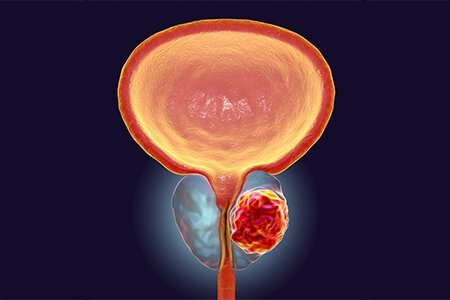
Prostate cancer is the uncontrolled growth of cells in the prostate gland. It is one of the most commonly seen cancers in men and can often be treated successfully.
The prostate gland is a small, walnut-shaped organ found only in men, which produces the seminal fluid for nourishment and transportation of sperm.
What are the types of Prostate cancer?
Prostate cancer arises from the gland cells that make prostate fluid that is added to the semen. Prostate adenocarcinomas are the most common forms of prostate cancer. They can either be acinar adenocarcinomas (cancer of the gland cells that line the prostate gland) or ductal adenocarcinomas (cancer of cells that line the ducts or tubes of the prostate gland).
Other types of prostate cancer include:
Prostate sarcoma
Small cell carcinoma
Neuroendocrine tumors
Transitional cell or urothelial cancer
Some prostate cancers grow slowly and require regular monitoring. However, other types of prostate cancer are aggressive and need immediate treatments.
What are the symptoms of Prostate cancer?
In the early stages of prostate cancer, there may be no signs or symptoms. However, in advanced stages, men may experience following signs and symptoms:
Difficulty in urinating
Dripping of urine due to a decreased force in the stream
Presence of blood in semen
Pain or discomfort in the pelvic region
Bone pain
Erectile dysfunction
What are the causes and complications of Prostate cancer?
While there are no definitive causes, some factors that can increase the chances of developing prostate cancer include:
Age: More common with increasing age
Family history: Risk increases with the presence of disease in men of the same family
Obesity: Men diagnosed with prostate cancer may be difficult to treat if they are obese
Some complications of prostate cancer are:
Metastasis: Spreading of cancer to the nearby organs like bladder, bones and distant organs.
Metastatic castration-resistant prostate cancer: Usually, prostate cancer subsides with below-normal testosterone. When prostate cancer progress and metastases even with reducing or depletion of testosterone, it is called castration-resistant prostate cancer.
Incontinence: Incontinence is the lack of self-restraint over urination and defecation. Cancer itself and its treatment may lead to urinary incontinence.
Erectile dysfunction (ED): Also known as impotence, ED is a condition where a man cannot achieve or maintain a firm erection for sexual intercourse. This can occur as a result of the prostate cancer or its treatment.
How is prostate cancer diagnosed?
Consult a urologist if any signs or symptoms bother you. You may be referred to an oncologist if required. Diagnostic tests for prostate cancer might include:
– Medical history
– Examination and screening:
Digital rectal exam (DRE): Examination by putting a lubricated and gloved finger in the rectum.
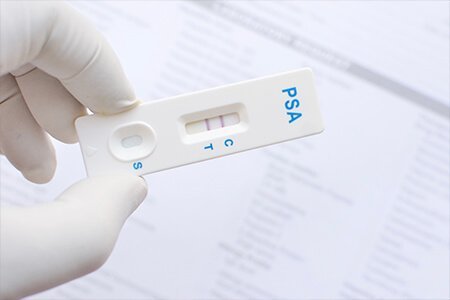
Prostate-specific antigen (PSA) test: As per the US National Library of Medicine, normal PSA level is around 4.0 nanograms per milliliter (ng/mL) of blood
What are the stages of Prostate cancer and PSA levels?
After identifying prostate cancer, doctors try to figure out its size and extent of spread. This process is called the staging of prostate cancer. It also helps the oncologist to decide the treatment plan.
Cancer staging is done in two ways: TNM (Tumour, Node, Metastasis) staging and Number staging from 1 to 4.
What is PSA? What is its importance in staging prostate cancer?
Prostate-specific antigen (PSA) is a protein secreted by the prostate gland. Some conditions such as prostatitis, benign prostatic hyperplasia (enlarged prostate) and prostate cancer result in elevated PSA levels in the body. Thus, the PSA level is one among the other tools that are used for staging prostate cancer. PSA level in the range of 4 to 10 ng/mL is suspicious and doctors may suggest screening for prostate cancer.
Stages of prostate cancer:
Stage 1: The cancer is localized and has not spread to lymph nodes. The PSA level is less than 10 and graded as group 1.
Stage 2: The cancer is localized and has not spread outside the prostate or lymph nodes. The PSA level is less than 20. The prostate cancer stage 2A, stage 2B, and stage 2C are graded as group 1, group 2 and group 3 or 4, respectively.
Stage 3: In stage 3A, the cancer is confined within the prostate and the PSA value is at least 20. As cancer progresses to stage 3B, it grows into the seminal vesicles and surrounding tissues such as the urethral sphincter, rectum, bladder and/or wall of the pelvis. However, in stage 3, cancer has not yet spread to the lymph nodes. The grade group of prostate cancer at stage 3A and stage 3B are group 1 to 4; at stage 3C it is group 5.
Stage 4: In stage 4A, cancer has spread to the lymph nodes but cancer has not spread elsewhere in the body. As cancer progresses to stage 4B, it spreads to other, distant parts of the body. The grade group and PSA value vary broadly.
How is Prostate cancer treated?
The treatment options for prostate cancer are based on the type and stage of prostate cancer and other factors like overall health, age, and sensitivity to certain medications.
Active surveillance includes regular follow-up with blood tests, rectal examinations, and biopsy, if required, to evaluate and monitor the progression of prostate cancer.
The conservative approaches include:
Radiation therapy
Chemotherapy
Hormone therapy to stop the production of testosterone
Biologic therapy: Makes use of the body’s immune system to fight cancer cells
Freezing of the prostate cancer tissue (Cryosurgery or cryoablation)
The surgical approach for prostate cancer depends on the stage of the prostate cancer, as well as the risk factors in a particular patient.
Radical prostatectomy: Radical prostatectomy is a major surgery recommended by doctors for patients with prostate cancer. In this surgery, the prostate gland and the surrounding tissue with some lymph nodes are removed. The surgery can be performed in the following ways:
Robot-assisted surgery
Open surgery by making an incision in the abdomen
robot-assisted prostatectomy, the surgery is done using a robotic system. During the surgery, the surgeon uses the control panel in the operating room to move the robotic arms and operate through several small incisions (cuts) in the patient’s abdomen. The robotic arms allow freedom of motion similar to the surgeon’s hand; an improvement over the traditional laparoscopic tools.
What is the survival rate for prostate cancer?
Survival rates are often used by doctors to determine the patient’s prognosis. The 5-year survival rate implies the percentage of people surviving 5 years after the diagnosis of their disease. It depends on many factors like the overall health of the patient, stage, and site of the tumor.
The 5-year relative survival rate for prostate cancer is 99%
The 10-year relative survival rate for prostate cancer is 98%
The 15-year relative survival rate for prostate cancer is 96%
The 5-year relative survival rate for local stage prostate cancer is 100% (stage 0 – 3). About 4 out of 5 prostate cancers are diagnosed in these stages.
The 5-year relative survival rate for regional stage prostate cancer is 100% (stage 3B and 4A).
The 5-year relative survival rate for regional stage prostate cancer is 29% (stage 4B).
How can Prostate cancer be prevented?
Even though there are no certain causes, the risk for prostate cancer can be reduced by engaging in
A healthy diet
Regular exercise
Avoidance of alcohol/ smoking/tobacco chewing etc.
Talk to your doctor about increased risk for prostate cancer
To know more about prostate cancer and its treatment, you can request a callback and our prostate cancer specialist will call you and answer all your queries.
MD Med(USA), DM Onc(USA), DM Heme (USA) Diplomate, American Board of Medicine, Oncology. & Hematology Marrow Transplant Physician, University of Washington, Seattle, Asst. Professor, Oncology & Hematology., University of California, Davis. Advisor, National Physicians' Advisory Board, USA.
Senior Consultant Hematologist & Medical Oncologist
MS (General Surgery), DNB (MNAMS), Fellowship in GI and Laparoscopic Surgery, MRCS (Edinburgh, UK), MCh (Surgical Oncology), DNB (MNAMS), Fellowship in Robotic Surgery
Sr. Consultant Surgical Oncologist & Robotic Surgeon(Cancer Specialist) Clinical Director
Mayo Clinic. Prostate Cancer. Available at: https://www.mayoclinic.org/diseases-conditions/prostate-cancer/diagnosis-treatment/drc-20353093 Accessed on January 31, 2018
National cancer institute. Prostate Cancer Treatment (PDQ®)–Patient Version. Available at: https://www.cancer.gov/types/prostate/patient/prostate-treatment-pdq Accessed on January 31, 2018
Prostate cancer. American Cancer Society. https://www.cancer.org/cancer/prostate-cancer.html. Accessed on January 31, 2018
Disclaimer: The content of this publication has been developed by a third party content provider who is clinicians and/or medical writers and/or experts. The information contained herein is for educational purpose only and we request you to please consult a Registered Medical Practitioner or Doctor before deciding the appropriate diagnosis and treatment plan.











































 Appointment
 Second Opinion
 Live Chat
 Call
Call More
More