


Runner’s Knee vs. ITBS: Symptoms, Diagnosis, Treatment, and When to See a Doctor

Knee pain is common among runners and may develop when the body is exposed to sudden changes in training, such as increasing mileage too quickly, running at a higher intensity, adding more hill workouts, or not allowing enough time for recovery between sessions. Repetitive stress on the knee can place extra strain on the muscles, tendons, and tissues around the joint. Two common causes of running-related knee pain are runner’s knee (patellofemoral pain syndrome) and iliotibial band syndrome (ITBS). While both can cause discomfort during or after running, their symptoms and typical pain locations are different.
Runner’s knee usually causes pain around or behind the kneecap and may become more noticeable when running, climbing stairs, squatting, or sitting with the knees bent for extended periods. IT band syndrome, on the other hand, typically causes pain on the outer side of the knee and may worsen during running, particularly during longer runs or downhill running. Recognizing these differences can help runners understand their symptoms and take appropriate steps, such as reducing activities that aggravate the pain, allowing adequate recovery, and gradually returning to training. If knee pain is severe, persistent, worsening, associated with swelling or instability, or does not improve with rest and basic self-care, seeking medical advice can help identify the underlying cause and guide appropriate treatment.
What Is Runner’s Knee?
Runner’s knee, also known as patellofemoral pain syndrome (PFPS), is a common condition that causes pain around or behind the kneecap. It is often linked to repetitive stress on the knee and changes in how the hip, thigh, and knee work together during movement.
Although it is commonly seen in runners, runner’s knee can also affect people who participate in activities that involve repeated knee movements, such as cycling, jumping, squatting, or climbing stairs.
Runner’s Knee Symptoms
Runner’s knee symptoms may develop gradually and can vary from person to person. Common symptoms include:
- Pain around or behind the kneecap
- Aching or discomfort at the front of the knee
- Knee pain during or after running
- Pain while climbing or descending stairs
- Discomfort during squats, lunges, or similar activities
- Pain or stiffness after sitting for a prolonged period with the knee bent
- Grinding, clicking, or popping sensations around the kneecap in some people
The pain may become more noticeable with activities that put repeated stress on the kneecap. In many cases, symptoms develop over time rather than following a single injury.
Runner’s Knee Causes
Runner’s knee causes can result from a combination of factors that place increased stress on the kneecap and surrounding structures. Common contributing causes for Runner’s Knee include:
- Repetitive activities such as running, jumping, or squatting
- A sudden increase in training intensity, distance, or frequency
- Muscle weakness or imbalance involving the hips, thighs, or glutes
- Poor control of the leg during movement
- Changes in training surfaces or routines
- Improper movement mechanics during running or exercise
The underlying cause can differ between individuals, and several factors may contribute to the development of symptoms.
What Is IT Band Syndrome?
IT band syndrome (ITBS), also called iliotibial band syndrome, is an overuse condition that commonly causes pain on the outer side of the knee. The iliotibial band is a strong band of connective tissue that extends along the outside of the thigh from the hip toward the knee.
Repeated bending and straightening of the knee, particularly during activities such as running and cycling, can irritate the tissues around the iliotibial band and lead to IT band pain or outer knee pain.
IT Band Syndrome Symptoms
IT band syndrome symptoms are typically felt on the outside of the knee and may become more noticeable during repetitive activities. Common symptoms include:
- Pain or tenderness on the outer side of the knee
- Pain that develops or worsens during running or cycling
- Discomfort when repeatedly bending and straightening the knee
- Pain that may become more noticeable after a certain distance or duration of exercise
- Tenderness around the outer knee
- Pain that may improve with rest but return when activity is resumed
IT Band Syndrome Causes
IT band syndrome is generally associated with repetitive stress and overuse. Several factors may increase the likelihood of developing the condition, including:
- A sudden increase in running distance or training volume
- Increasing running speed or intensity too quickly
- Frequent downhill running
- Running on uneven or banked surfaces
- Repetitive training without adequate recovery
- Weakness in the hip and glute muscles
- Changes in training routine or activity level
- Poor control or alignment of the leg during running
Not everyone with IT band syndrome has the same underlying contributing factors. Identifying the activities and movement patterns that aggravate the symptoms can help guide appropriate treatment and prevention strategies.
Runner’s Knee vs. ITBS: What Is the Difference?
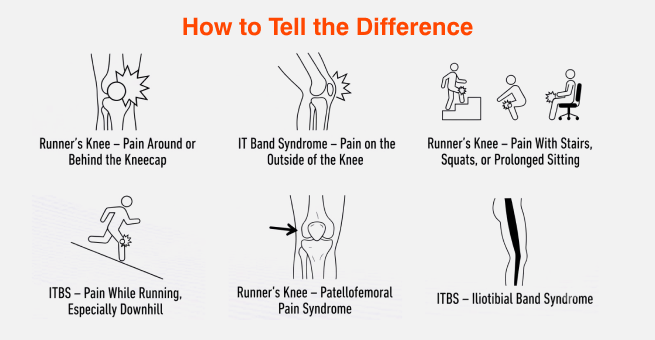
The location of pain is one of the most useful clues when comparing these two conditions.
| Feature | Runner’s Knee | IT Band Syndrome |
| Pain location | Around or behind the kneecap | Outside of the knee |
| Common name | Patellofemoral pain syndrome | ITBS |
| Pain pattern | Often aching or soreness | Often sharp or burning |
| Common triggers | Running, stairs, squats, and prolonged sitting | Running, especially longer distances or downhill |
| Main area involved | Kneecap and surrounding structures | Iliotibial band and outer knee |
While these patterns can be helpful, they cannot confirm a diagnosis. Other knee conditions can cause similar symptoms.
Diagnosis of Runner’s Knee and ITBS
A doctor or physiotherapist will usually begin by asking about your symptoms, running routine, recent changes in activity, and any previous knee problems.
The assessment may include:
- Checking where the pain occurs
- Examining knee movement
- Assessing muscle strength and flexibility
- Looking at hip and leg movement
- Assessing your running or walking mechanics when appropriate
- Checking for signs that could indicate another knee problem
Imaging is not always required. Your doctor may recommend imaging when symptoms are persistent, severe, unusual, or when another condition needs to be ruled out.
Indications of Runner’s Knee and ITBS
You can look at the location of pain and the activities that trigger it, but self-diagnosis is not always reliable.
- Runner’s knee: Pain is mainly around the kneecap and may worsen with activities such as running, climbing stairs, squatting, or prolonged sitting.
- ITBS: Pain is mainly concentrated on the outer aspect of the knee and may occur during running, particularly after prolonged running or while running downhill.
A doctor or physiotherapist can assess knee movement, muscle strength, flexibility, and running mechanics to determine the likely cause.
Can You Have Both Runner’s Knee and ITBS?
It is possible to experience symptoms of both runner’s knee and ITBS. Since different knee conditions can cause similar symptoms, pain location alone cannot confirm the diagnosis. If knee pain persists or keeps returning, a doctor or physiotherapist can assess the underlying cause and recommend appropriate treatment.
Runner’s Knee Diagnosis and Treatment
Diagnosis of Runner’s Knee
Runner’s knee is usually diagnosed through a detailed medical history and physical examination. A doctor may assess the location and pattern of pain, knee movement, muscle strength, flexibility, and the way the hip and leg move during activities such as walking, squatting, or running.
Imaging tests are not always required. Depending on your symptoms and examination findings, your doctor may recommend imaging to rule out other causes of knee pain or investigate per
sistent symptoms.
Get Relief from Runner’s Knee Pain with the Right Treatment
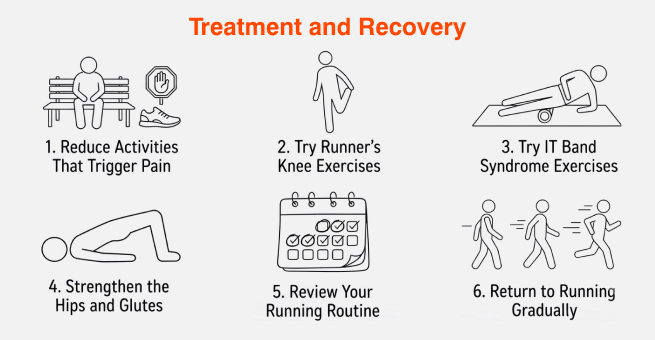
Runner’s knee treatment depends on the severity of symptoms and the factors contributing to the condition. Treatment may include activity modification, pain-relief measures, physiotherapy, strengthening exercises, and a gradual return to running.
1. Reduce Painful Activities
Temporarily reduce running, jumping, deep squats, and other activities that increase your pain. You do not necessarily need complete rest. Low-impact activities may be suitable if they do not worsen your symptoms.
2. Apply Ice
A cold pack may provide short-term relief after activity. Wrap the cold pack in
a towel and avoid placing ice directly on your skin.
3. Follow Runner’s Knee Exercises
Strengthening the muscles around the hip, thigh, and knee can be an important part of rehabilitation.
Common runner’s knee exercises may include:
- Straight-leg raises
- Glute bridges
- Clamshells
- Side-lying leg raises
- Step-ups
- Controlled squats
A physiotherapist can recommend the most appropriate exercises and progression based on your symptoms, strength, and movement pattern.
4. Medical Treatment and Physiotherapy
Depending on the severity and cause of your symptoms, your doctor may recommend physiotherapy as part of treatment. A physiotherapist can work on muscle strength, flexibility, movement control, and a gradual return to running.
Pain-relieving medication may also be recommended when appropriate. The choice of medication should be discussed with a healthcare professional, particularly if you have other medical conditions or take other medicines.
5. Return to Running Gradually
Avoid returning immediately to your previous running distance or intensity. Increase your training gradually and monitor how your knee responds.
IT Band Syndrome Diagnosis and Treatment
Diagnosis of IT Band Syndrome
IT band syndrome (ITBS) is usually diagnosed based on your symptoms, medical history, and physical examination. Your doctor may assess the location of pain, knee movement, hip and leg strength, flexibility, and factors related to your running technique and training routine.
Imaging may not be necessary in every case but can be considered when symptoms are persistent, severe, unusual, or when another condition needs to be ruled out.
Get Relief from IT Band Syndrome with the Right Treatment
IT band syndrome treatment focuses on reducing irritation, addressing factors that
may have contributed to the condition, improving strength and movement, and gradually returning to normal activity.
1. Reduce Activities That Trigger Pain
Temporarily reduce or stop running if it consistently reproduces your outer-knee pain. As symptoms improve, activity can be gradually increased.
2. Review Your Training
Your doctor or physiotherapist may review recent changes in your running routine, including:
- Increased mileage
- Added hill workouts
- Increased running speed
- Changes in running surface
- Increased training frequency
- Reduced rest days
Addressing these factors can be an important part of recovery.
3. Follow IT Band Syndrome Exercises
IT band syndrome exercises often focus on strengthening the hip and gluteal muscles and improving control of the leg.
Depending on your individual needs, exercises may include:
- Side-lying hip abduction
- Glute bridges
- Clamshells
- Hip strengthening exercises
- Controlled single-leg exercises
A physiotherapist can recommend exercises and progression based on your movement pattern and symptoms.
4. Medical Treatment and Physiotherapy
Physiotherapy may be recommended to address muscle weakness, movement patterns, flexibility, and training-related factors. Your healthcare professional may also advise appropriate pain-relief measures based on your symptoms and medical history.
Persistent symptoms may require further evaluation to rule out other causes of outer-knee pain.
5. Gradually Return to Running
Once your pain has improved, gradually reintroduce running. Avoid suddenly returning to long-distance or high-intensity training.
Runner’s Knee Recovery
Runner’s knee recovery varies from person to person. Recovery depends on the severity of symptoms, the underlying contributing factors, activity level, and response to treatment.
Following the recommended rehabilitation programme and addressing factors that may have contributed to the condition can support recovery. Returning to running too quickly may cause symptoms to return.
IT Band Syndrome Recovery
ITBS recovery also depends on the severity of symptoms and the factors contributing to the condition.
During recovery:
- Avoid activities that significantly increase pain
- Follow a progressive strengthening programme
- Complete recommended physiotherapy exercises
- Review your training load
- Allow adequate recovery between workouts
- Return to running gradually
If symptoms continue despite treatment, further medical assessment may be needed to determine whether another condition is causing the pain.
Can You Treat Runner’s Knee and ITBS at Home?
Mild cases of runner’s knee and iliotibial band syndrome (ITBS) may improve with home treatment, including activity modification, ice application for temporary pain relief, stretching, and appropriate strengthening exercises. However, home remedies may not be suitable for everyone.
If knee pain is severe, persistent, worsening, or affecting daily activities, consult an orthopaedic specialist for proper diagnosis and treatment. Professional evaluation is also recommended to determine whether the symptoms are caused by runner’s knee, ITBS, or another knee condition.
When Should You See a Doctor?
If you experience persistent knee pain after running or exercise, it is important to consult an orthopaedic or sports medicine specialist for proper evaluation. Seek medical attention if you have:
- Severe or worsening knee pain
- Significant knee swelling
- Difficulty walking or bearing weight on the affected leg
- A knee that locks or gets stuck
- Frequent knee instability or giving way
- Pain that does not improve with rest or home treatment
- Recurrent knee pain after running
- Difficulty performing routine daily activities
- Knee pain that develops after a significant injury
Prompt medical evaluation is especially important if knee pain is associated with severe swelling, instability, or difficulty bearing weight, as these symptoms may require timely diagnosis and treatment.
Prevention Tips for Runner’s Knee and ITBS
Runner’s knee and iliotibial band syndrome (ITBS) can often be prevented by following healthy running practices and giving your body adequate time to adapt and recover. These tips may help reduce the risk of knee pain and running-related injuries:
- Increase running distance gradually: Avoid sudden increases in mileage or training volume.
- Build training intensity slowly: Gradually increase speed, hills, and workout intensity to reduce strain on the knees.
- Include strength training: Strengthen the quadriceps, hamstrings, glutes, and hip muscles to improve knee stability and support.
- Warm up before running: Perform light aerobic activity and dynamic stretches before your run.
- Allow adequate recovery: Give your muscles and joints enough time to rest and recover between workouts.
- Maintain flexibility: Regular stretching and mobility exercises can help maintain healthy movement and reduce muscle tightness.
- Wear appropriate running shoes: Choose well-fitting, supportive running shoes that suit your foot type and running needs.
- Avoid running through pain: Persistent or worsening knee pain should not be ignored.
- Vary your training: Where appropriate, alternate running with low-impact activities such as cycling or swimming.
- Address recurring knee pain early: Consult a healthcare professional if knee pain keeps returning or affects your running or daily activities.
Following these preventive measures can support healthy running habits and help reduce the risk of runner’s knee and ITBS.
Conclusion
Runner’s knee and IT band syndrome (ITBS) are common causes of running-related knee pain, but they typically affect different areas. Runner’s knee usually causes pain around or behind the kneecap, while ITBS commonly causes pain on the outside of the knee.
Identifying the symptoms early and getting an accurate diagnosis can help guide the right treatment. With appropriate medical care, physiotherapy, targeted exercises, and a gradual return to activity, runners can work towards reducing pain and safely returning to their routine. If knee pain is persistent, severe, or keeps coming back, consult an orthopaedic or sports medicine specialist for proper evaluation and treatment.
Don’t Ignore Recurring Knee Pain. Get the right diagnosis and treatment at Yashoda Hospitals. Book Your Consultation
About Author

Dr. Sai Thirumal Rao Veerla
MS(Ortho)Fellowship In Arthroscopy & Sports Medicine (Cardiff, UK),
Fellowship in Arthroplasty (Germany),
Dip. In Sports Medicine (IOC)
Senior Consultant Specializing in Arthroscopy & Joint Replacement
FAQs
1. What is runner’s knee?
Runner’s knee is a common term for pain around or behind the kneecap, medically known as patellofemoral pain syndrome. It can occur due to repetitive stress and problems with movement or muscle control around the hip and knee.
2. What are the common runner’s knee symptoms?
Common symptoms include pain around the kneecap, aching at the front of the knee, discomfort while running, pain on stairs, pain during squats, and discomfort after sitting with the knee bent for a long time.
3. What is the best runner’s knee treatment?
Treatment depends on the cause and severity of symptoms. Activity modification, strengthening exercises, and a gradual return to running are commonly used approaches. A healthcare professional should evaluate persistent symptoms.
4. Which runner’s knee exercises can I do at home?
Depending on your symptoms, exercises such as straight-leg raises, glute bridges, clamshells, side-lying leg raises, and controlled step-ups may be included in rehabilitation.
5. What are the main IT band syndrome causes?
IT band syndrome causes can include sudden increases in running mileage or intensity, frequent downhill running, changes in training, repetitive activity, and weakness or poor control around the hip and leg.
6. What is IT band friction syndrome?
IT band friction syndrome is another term used for iliotibial band syndrome. It is an overuse condition that commonly causes pain on the outside of the knee, particularly during repetitive activities such as running.
7. What is the best IT band syndrome treatment?
IT band syndrome treatment generally involves reducing activities that aggravate symptoms, addressing contributing training factors, and following an appropriate strengthening and rehabilitation programme.
8. What IT band syndrome exercises can help?
Exercises that strengthen the hip and gluteal muscles may be included in an ITBS rehabilitation programme. A physiotherapist can recommend exercises based on your individual needs.
9. How long does runner’s knee recovery take?
Runner’s knee recovery varies depending on the severity of symptoms, activity level and response to treatment. Gradually increasing activity after symptoms improve can help reduce the risk of recurrence.
10. Where does ITBS knee pain usually occur?
ITBS knee pain typically occurs on the outer side of the knee. It may become noticeable during running and can worsen with continued activity.
11. Can I continue running with IT band syndrome?
If running consistently causes or increases your pain, reduce or temporarily stop running. Gradual return to running is usually preferable once symptoms have improved.
12. When should I see a doctor for runner’s knee or ITBS?
See a doctor if your pain is severe, persistent, or worsening, or if you have significant swelling, difficulty bearing weight, locking, or instability. Professional assessment can also help if home treatment does not improve your symptoms.







 Appointment
 Second Opinion
 Live Chat
 Call
 More